
ERC Consolidator Grants awarded to eleven Oxford academics
Eleven academics from the University of Oxford are to lead new research projects supported by European Research Council (ERC) Consolidator Grants. These grants support highly promising mid-career scientists of any nationality and any field with building a research team at an eligible host organisation.
Consolidator Grants award around €2 million for projects typically lasting 5 years. Awardees must have 7-12 years of highly promising postdoctoral experience plus an excellent research proposal. With funding from the EU’s Horizon Europe programme, these grants will support cutting-edge research at universities and research centres in 25 EU Member States and associated countries. The ERC received 3,121 applications for this call, of which 11.2% were successful.
Oxford received more grants than any other institution in the UK. The eleven Oxford grantees are:
Associate Professor Jesús Aguirre-Gutiérrez, Environmental Change Institute (ECI)
Dr Dan Batovici, Faculty of Theology and Religion
Associate Professor Alexander Clarke, Kennedy Institute for Rheumatology
Associate Professor Fernanda Duarte, Department of Chemistry and Fellow at Hertford College
Associate Professor Armin Lak, Department of Physiology, Anatomy, and Genetics (DPAG) and Fellow of St John’s College
Professor James Maynard, Mathematical Institute and Fellow of St John’s College
Professor Pier Palamara, Department of Statistics and Fellow of Corpus Christi College
Dr Ján Pich, Royal Society Research Fellow at the Department of Computer Science
Professor Rob Salguero-Gómez, Department of Biology and Fellow of Pembroke College
Professor Erin E Saupe, Department of Earth Sciences and Senior Research Fellow at St Hugh’s College
Professor Robert Weatherup, Department of Materials and Fellow of The Queen's College
Commenting on the awards for the Mathematical, Physical, and Life Sciences Division (MPLS), Prof James (Jim) Naismith, Head of MPLS, said 'These ERC awards recognise exceptional ambition and talent. Each project has the potential to deepen scientific understanding and deliver tangible benefits for society – from biodiversity and climate resilience to sustainable technologies and advanced chemistry.'
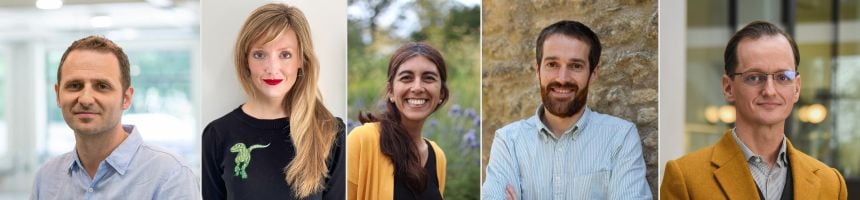 Oxford University ERC Consilidator Grant awardees 2025: left to right: Pier Palamara, Erin E Saupe, Fernanda Duarte, Robert Weatherup, Rob Salguero-Gómez
About the Oxford recipients
ADAPTA
The ADAPTA project (Tropical Forest Adaptation to a Changing Biosphere) is led by Jesús Aguirre-Gutiérrez, Associate Professor at the Environmental Change Institute (ECI). The project will explore the resilience of tropical forests at a pan-tropical scale, advancing our understanding of how these critical ecosystems respond to accelerating environmental change. Associate Professor Aguirre-Gutiérrez said ‘I am deeply grateful to my family, friends and collaborators around the tropics with whom I have developed all these crazy ideas, and with whom I look forward to developing this project in the years ahead.’
ARGgen
Genealogical graphs capture how genomes are connected through shared ancestors, making it easier to detect structure in the data. This grant will enable us to build methods that can handle the scale and diversity of modern biobank datasets, providing new insights into human evolutionary history and heritable traits. I am very grateful to the ERC, and to my team and collaborators.
Prof Pier Palamara
Pier Palamara, Professor of Statistical Genomics in Oxford’s Department of Statistics and Fellow of Corpus Christi College, develops statistical and computational methods to analyse large genetic datasets. His work focuses on modelling human genetic variation and evolutionary history, and on developing analytical tools to study the genetic factors that influence heritable traits and diseases.
The ARGgen project will develop a framework for creating large-scale genealogical models that describe how genomes are connected through shared ancestors. These models make it easier and more accurate to analyse genetic data at scale and allow researchers to study human evolutionary history. The project will also introduce new approaches to identifying variants associated with heritable traits and diseases in large and diverse datasets.
EXTINCT
Extinction has occurred continuously over the history of life on Earth. However, there is still little understanding of the drivers of extinction across timescales. In EXTINCT, Erin E Saupe (Professor of Palaeobiology at the Department of Earth Sciences and Senior Research Fellow at St Hugh’s College) will develop new ways of determining what causes marine invertebrates to die out. The project will look at patterns across different places and time periods.
This grant enables us to explore the drivers of extinction throughout Earth’s history and to contribute to modern-day conservation efforts. We are excited to develop novel methods and models to tackle these challenges. I am grateful to the ERC funders, to my collaborators for their support and mentorship, and to my group members for their inspiration, dedication, and hard work in this area.
Prof Erin E Saupe
On long timescales, the project will test the importance of environmental stressors in driving species-level extinction. The method will involve new paleoenvironmental reconstructions – using geological and chemical evidence in Earth system models to recreate past environmental conditions.
On shorter timescales, the project will examine population-level dynamics to test whether local extinction is prompted by similar environmental stressors across a species’ geographic range and through time.
The project will also determine which species are most vulnerable to extinction under current and future human-caused climate change scenarios. Risk estimates will be based on the paleontological models, which will be fed into International Union for Conservation of Nature and Natural Resources (IUCN) Red List assessments of extinction vulnerability, providing conservation insight.
This research aims to deliver a step change in our understanding of the controls on extinction, which will directly impact modern biodiversity.
LearningTrajectories
The LearningTrajectories project is led by Armin Lak, Associate Professor of Neuroscience at the Department of Physiology, Anatomy, and Genetics (DPAG) and Fellow of St John’s College. It seeks to understand neuronal circuits underlying individual learning trajectories.
Many abilities such as playing football or choosing food from a restaurant menu are learned. Different individuals learn in drastically diverse ways. However, the brain signals underlying individual diversity in learning remain unknown. LearningTrajectories aims to address this fundamental knowledge gap by monitoring neuronal activity throughout the whole process of learning, from naïve to expert. The results may also help us to understand conditions where people struggle to learn.
ML4MetaLigM
The project ML4MetaLigM will develop new computational methods to model chemical reactions that occur in liquid solution. Led by Associate Professor Fernanda Duarte (Department of Chemistry, Chemistry Fellow at Hertford College), the project will focus on challenging systems containing metals.
This project bridges a critical gap between theory and applications in chemistry, by creating predictive and accessible tools. I am grateful to my team, past and present members, and collaborators whose feedback and support were key in shaping this proposal.
Associate Prof Fernanda Duarte
Metal ions are essential for biological and technological functions, including protein function, acceleration of chemical reactions (catalysis), and development of advanced materials. But predicting their behaviour in real-world conditions is difficult. This is limiting progress in areas such as drug discovery and the sustainable synthesis of materials.
By combining physics-based models with AI and experimental validation, the project will accurately describe metal-ligand interactions, reveal fundamental mechanisms behind processes such as self-assembly and catalysis, and guide the design of new catalysts and metalloenzyme inhibitors (drug-like molecules that target enzymes containing a metal ion). These advances will transform molecular modelling and accelerate the design of new molecules with tailored functionalities.
OPERATE
Current chemical and fuel production methods are driving climate change. The OPERATE project (Operando Probing of Electrochemical Reactions At Triple-phase-boundaries) seeks to make chemicals and fuels more sustainable by decarbonising their production.
What excites me most is the opportunity to pioneer new approaches for automating catalyst discovery and to advance operando techniques that reveal how catalysts behave under truly realistic device conditions. The long-term support from this ERC grant will allow us to uncover how catalysts really function and guide the design of next-generation sustainable technologies.
Prof Robert Weatherup
This requires efficient electrochemical reactions that turn water and carbon dioxide into useful products. However, these reactions take place at complex ‘triple-phase’ boundaries where solids, liquids and gases meet. Such phases are extremely difficult to study.
OPERATE, led by Robert Weatherup (Professor of Energy Materials at the Department of Materials and Fellow of The Queen's College) will develop new ways to observe these reactions in real time, using advanced X-ray techniques and precisely engineered nanoparticle catalysts.
The project will use and develop operando methodologies; analysing a material inside its working environment while simultaneously measuring its performance. In this case, tracking structural and chemical changes of the nanoparticle catalysts while measuring the voltage and current applied to them. These methods provide a ‘live view’ into the functional world of materials.
By revealing how catalysts change during operation, the project will guide the design of improved systems for producing sustainable fuels and chemicals, helping to drive society’s transition to Net Zero.
PraDa
PraDa (New structures in primes and Diophantine approximation) is led by James Maynard, Professor of Number Theory at the Mathematical Institute and Fellow of St John’s College.
Prime numbers are fundamental objects in pure mathematics. Their importance isn’t simply theoretical; many critical computer algorithms rely on assumptions about the distribution of primes. Despite this, and thousands of years of study, many of the basic questions about primes remain unsolved. The PraDa project will develop new mathematical tools to understand long-standing questions on prime numbers.
‘This project excites me because it aims to tackle some of the most central and notorious problems in pure mathematics,’ said Prof Maynard. ‘The long-term funding will help to maintain Oxford's position as a leading centre worldwide for such questions, and help attract the strongest young researchers to come and work in Oxford.’
ResIntegrate
From heatwaves and droughts to invasive species and human pressures, nature is facing unprecedented, interacting challenges. A key challenge for scientists is predicting resilience – which species, populations, or ecosystems will bounce back, and which will collapse?
ResIntegrate will finally let us read nature’s ‘resilience code’. By uniting big data, global experiments, and novel, holistic theory, we will uncover what allows life to persist through upheaval. With that knowledge we can better protect the world we depend on from multiple, interacting disturbances.
Prof Rob Salguero-Gómez
ResIntegrate, led by Professor of Ecology Rob Salguero-Gómez (Department of Biology and Fellow of Pembroke College) aims to uncover what makes nature resilient. The project brings together individuals, populations, communities, and ecosystems into one unified vision. Using mathematical theory, global biodiversity databases, and field experiments, the project will reveal the hidden rules that determine whether life withstands, adapts to, or is transformed by disturbances.
The ambition is bold but urgent: to provide the predictive tools needed to safeguard biodiversity. Resilience will become measurable, comparable, and actionable.
About the ERC
The ERC, set up by the European Union in 2007, funds creative researchers of any nationality and age, to run projects based across Europe. The ERC offers four core grant schemes: Starting Grants, Consolidator Grants, Advanced Grants and Synergy Grants. With its additional Proof of Concept Grant scheme, the ERC helps grantees to bridge the gap between their pioneering research and early phases of its commercialisation. The ERC is led by an independent governing body, the Scientific Council. Further information about the 2025 ERC Consolidator Grants can be found on the European Research Council website.
For more information about this story or for image permissions, please contact [email protected].

 Oxford tops QS World University Rankings in four subjects, named overall top for Humanities
 New study finds that stored sperm deteriorates across the animal kingdom
 Oldest genetic evidence for domestic dogs identified in Europe and Türkiye
 Expert Comment: From frontier to feedback loop - Why space must become circular
 Blood test may improve survival of childhood cancer in Africa
 International award for outstanding collaboration on the Universe’s heaviest elements
 Expert Comment: National Emergency Briefing - Nature is not a ‘nice-to-have’, it is critical national infrastructure
 Researchers develop air-powered robots that move in sync without electronics