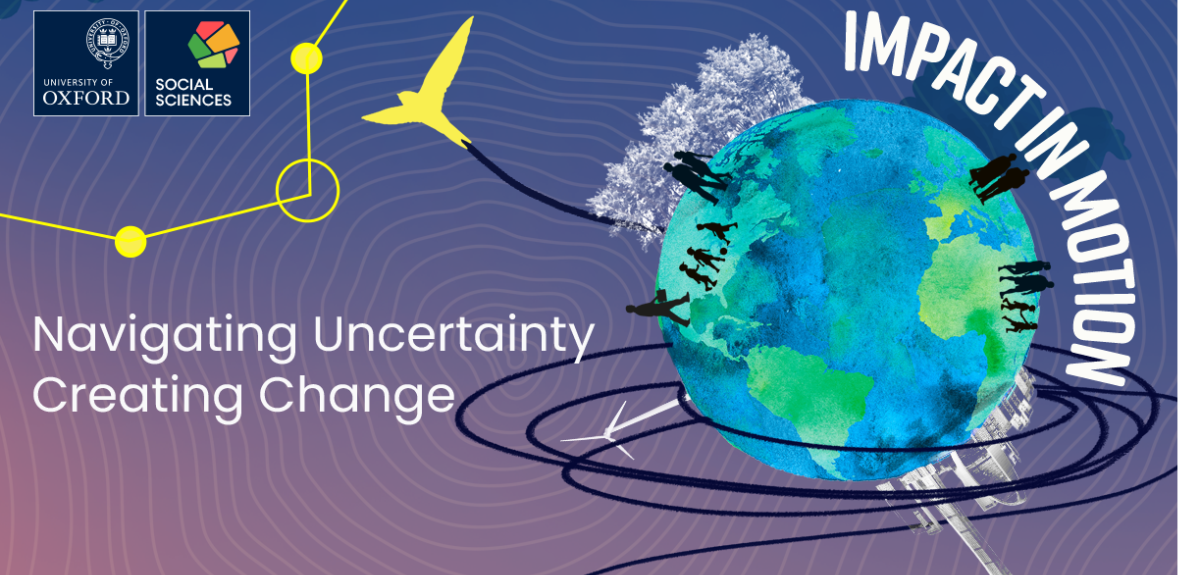
Social Sciences Impact Conference to bring together researchers and partners to explore ‘Impact in Motion’
The University of Oxford’s Social Sciences Division will host the Social Sciences Impact Conference on 24–25 March 2026 at St Anne’s College, Oxford - bringing together researchers, policymakers, practitioners and innovators to explore how social science can help address complex challenges and deliver meaningful change. The 2026 conference theme, Impact in Motion: Navigating Uncertainty, Creating Change, will examine how collaboration, openness, innovation and inclusion can help societies respond constructively in a rapidly changing world.
Researchers from more than 20 universities are expected to take part, including Oxford, Oxford Brookes, Cambridge, Manchester, UCL, Queen’s University Belfast, Exeter, Southampton, Bournemouth, Leicester, Royal Holloway, Cardiff, Huddersfield, Warwick, Birmingham and Sheffield. The programme will also feature speakers from organisations working across policy, international development, research funding and public engagement, including the Foreign, Commonwealth & Development Office, UNHCR, the British Academy, the International Rescue Committee, ESRC, BBC Ideas, the Scottish Parliament and the Senedd.
By convening researchers, policymakers, practitioners and partners, we create space for meaningful dialogue and collaboration across disciplines and sectors. In a time of complex global challenges, it is through these shared conversations and partnerships that social science research can inform policy, strengthen communities and drive real-world impact.
Professor Timothy Power, Head of Social Sciences Division
Professor Timothy Power, Head of Social Sciences Division, said: 'I am excited to see the social sciences community come together in Oxford for The Social Sciences Impact Conference. By convening researchers, policymakers, practitioners and partners, we create space for meaningful dialogue and collaboration across disciplines and sectors. In a time of complex global challenges, it is through these shared conversations and partnerships that social science research can inform policy, strengthen communities and drive real-world impact.'
The two-day conference will include plenary sessions and 24 additional sessions comprising deep dives, panel discussions and workshops. Topics span navigating international policy spaces, inclusive innovation and commercialisation, how the social sciences are meeting the climate change challenge, measuring, evidencing and evaluating impact, and film as an engagement tool.
The plenary programme includes Social Sciences in Motion: Power, Pressure and Potential, which will explore how forces such as political transition and shifts in the funding landscape are reshaping the sector, and what this means for future possibilities in research during a period of instability and uncertainty. Speakers include Julia Black, Will Hutton (Academy of Social Sciences), Professor Jonathan Michie (Kellogg College, University of Oxford), Molly Morgan Jones (The British Academy) and James Canton (ESRC: Economic and Social Research Council).
Trust, Credibility and Public Confidence: Are Social Sciences Doing Enough will bring together diverse perspectives for a critical discussion of how social sciences can maintain and build trust in an era of misinformation, polarisation and rapid technological change, and how the sector can demonstrate value to the public, policy, the media and business.
Impact at a Crossroads: Research and Action Amid Global Change will consider how international research and aid have shifted amid rising global tensions, and how researchers, policymakers and international organisations are adapting their work and navigating polarised environments while continuing to deliver impact. Speakers include Professor Lucie Cluver (Department of Social Policy and Intervention, University of Oxford) and Caesar Atuire (Oxford Global Health).
The programme will also feature Impact in Motion: The Path Ahead for the Social Sciences, with Professor Ngaire Woods (Blavatnik School of Government).
The conference’s official partner is the Campaign for Social Sciences, part of the Academy of Social Sciences, which advocates for the greater use of social science evidence in decision-making and highlights the contribution of applied research to public policy and society. The 2026 event is sponsored by Overton and Palgrave Macmillan.
Steve Grundy, Senior Campaign Manager, Academy of Social Science, said: ‘Social science research helps us to understand and address many of the varied challenges facing society today, providing vital evidence to inform government policy relating to the environment; the economy; health; education; criminal justice; immigration; technology including AI; housing; social welfare, and much more besides. As such the impact of social science research touches all our daily lives, making a significant and important contribution to improving society for the better.’
The conference offers in-person participation, with an online alternative planned for those unable to attend in person, providing access to 10 live sessions across the two days. Registration closes on 13 March 2026. Further information and booking details are available via the conference webpage.

 Oxford’s women triumph in historic 80th boat race
 Spectacular fossil treasure trove pushes back origins of complex animals
 Oxford scientists uncover how the brain resolves emotional ambiguity
 Expert Comment: In Claude We Trust? Evaluating the New Constitution
 Oxford tops QS World University Rankings in four subjects, named overall top for Humanities
 Professor Rebecca Eynon elected to prestigious Academy of Social Sciences Fellowship
 British Academy honours ten Oxford academics from the Humanities and Social Sciences
 Hope into Action: Social Sciences Impact Conference online