Features
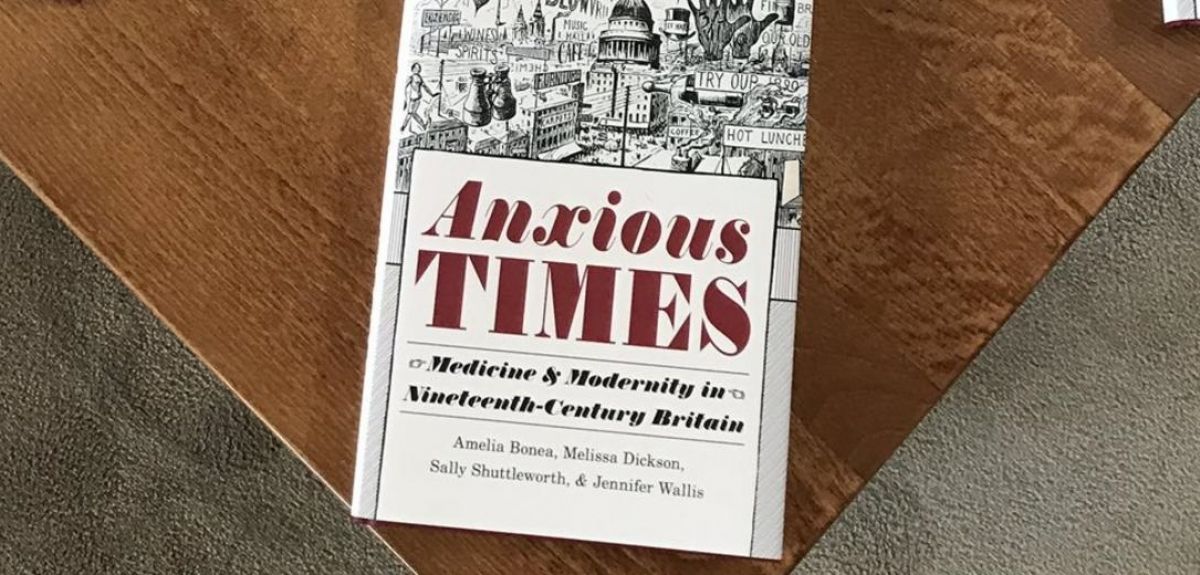
The Financial Times has just released its list of Business Books of 2019.
The list is mostly comprised of titles you would expect to see on CEOs’ shelves, such as books on management and big technology firms.
But one stands out from the rest: a book based on Oxford research into life and health in the Victorian times. It turns out Anxious Times: Medicine and Modernity in Nineteenth-Century Britain has a lot to teach us about modern life.
Written by Dr Amelia Bonea, Dr Melissa Dickson, Professor Sally Shuttleworth and Dr Jennifer Wallis, the book emerged out of the Diseases of Modern Life: 19th Century Perspectives research project at Oxford University.
Funded by the European Research Council, the project was led by Sally Shuttleworth, Professor English Literature at St Anne’s College. The project looks at how literature, science and medicine reflected the stresses of a rapidly changing society, finding many interesting parallels to our own.
Professor Shuttleworth was 'delighted' to hear the book was named in the list. She said: 'It was very unexpected. That said, when writing the book and running the project, we were very aware that the themes we were looking at are concerns for public health and business at the moment.'
In the FT's list, they say Anxious Times "makes the fascinating case that the stress and anxiety of the Victorians…foreshadowed our own age's problems with burnout and disruption".
Speaking about these parallels, Professor Shuttleworth said: 'I think it's of huge relevance to today's audiences and thinking. We spent time looking at what we now call "executive burnout", but that back then was called "overpressure".
'This had a lot to do with the coming of the telegraph, suddenly you had to work on a much wider, global scale, and you could be inundated with telegrams at all hours of night and day. Businesspeople in London would often even have telegraphs in their own homes, which really added to the pressures.'
If this sounds familiar – perhaps you too struggle from being always a phone call or email away from work - then you’re starting to understand a key parallel between modern day and Victorian times: the speed of technological change.
'I think every generation has a sense that things were better somehow in the past, but there are very strong parallels between now and the 19th century,' said Professor Shuttleworth. 'It's down to the rapidity of the change; if you think about that period, they went from being overwhelmingly agricultural to an industrial society in around 50 years.
'The railways carpeted the country, and with the creation of global telegraph lines, suddenly a letter that would have taken six months to get to Australia can be telegraphed in a matter of minutes. So the shift in how you orient yourself in the world and in your understanding of time and space is just remarkable. And I think that’s the same kind of issue we're coping with now.'
There are further similarities in the sheer amount of information available. The advent of the steam stress meant that people felt they were bombarded with print, while the new penny post led to a surge in advertising. We're seeing an echoing of that now, with concerns about how much space we have left where we’re not consuming information or being sold something.
Professor Shuttleworth recounted one story where: 'There's this wonderful description of a doctor being unable to eat their breakfast there were so many advertising flyers for drugs companies all over his table. So there was that same sense of being pressured to buy.'
It’s not just the similarities that may surprise readers. Anxious Times also uncovers some key differences in societal attitudes. Professor Shuttleworth explained: 'One of the big surprises was the way people were so sympathetic to sufferers from "overpressure" or "overwork".
'They accepted breakdowns as not being shameful, and would send executives off to health resorts for six months or more to recover. There was an understanding that convalescence required substantial time. I think that’s something that’s been completely lost.'
Given that kind of surprise, it becomes even clearer why this is vital reading for business. Professor Shuttleworth said: 'I think the lessons are that you shouldn't worry things are unprecedented. You can gain greater understanding of today's problems by placing them in historical perspective.
'There are also lessons to be learned from the ways in which the Victorians addressed the problems of industrial pollution which they had created, with local public health or 'sanitary' groups across the country getting together to measure air and water pollution, for example, and campaigning for legislation to control factory smoke,' she added.
'We tend to think of the "green city" movement as a creation of the twentieth century, but it also has its origins in the Victorian period. I was quite surprised and delighted to find all that!'
The Diseases of Modern Life research project has also had recent success in winning an Oxford Preservation Trust Award. Their Victorian Speed of Life light and sound show for Victorian Night Light was just named Best Temporary Project.
You can watch this in the video below, which uses projection and narration to give a whistle-stop tour of the research that went into the book.

By Kevin Grecksch and Jessica Holzhausen
Property rights are essential in western market societies and often taken for granted. They are ubiquitous and we do not question them. They are also a crucial element in the discussion of natural resource management.
In the context of climate change, understanding our concept of property rights, and how it influences our interpretation of who natural resources belong to, becomes increasingly important. At a basic level, property rights usually provide the owner exclusive, guaranteed rights, which always includes the notion of excludability. If an individual is the proprietor of a natural resource, this person determines access and allocation. This exclusive right is usually protected by the state. Problems stem from when property rights on resources cause inequalities of access to necessary resources like water, or are an obstacle for the successful implementation of climate adaptation measures.
Many would see property rights as ‘natural’ – yet they are far from natural. They express a social relationship that is very specific to western liberal democracies. For instance, many indigenous people have a concept of property and possession that does not serve the individual but society. It is often based on customary law with complex structures and rules to protect and regulate access to natural resources and the knowledge about it.
Property rights have been the subject of study of almost all well-known political theorists and philosophers. No matter if we talk about Thomas Hobbes, John Locke, Adam Smith or Jean-Jacques Rousseau, property rights always form an intricate part of the social contract that defines the relationship between individuals and the state. For John Locke, a key justification in favour of property rights is that the state guarantees the exclusiveness of a property and defends a person’s right to it. To this day Locke’s justification is a cornerstone of political and economic reasoning in the United States of America. To question property rights is to question the very reason of the state.
On the other hand, we find theorists like the French 19th century anarchist Pierre-Joseph Proudhon. He claimed that ‘property is robbery’ and argued that the property of the nobility and the clergy was based on faineance (i.e. indolence) because the wealth was not earned through labour, but instead stolen from those who laboured to create wealth. Or as the American unionist Bill Haywood said: The mine owners did not find the gold, they did not mine the gold, they did not mill the gold, but by some weird alchemy all the gold belonged to them!
In recent decades, property rights have been discussed mainly within a law and economics framework, thereby neglecting other perspectives. With environmental and societal challenges such as climate change reaching the top of political and social agendas, property rights may prove again to be a crucial issue. However, we find that the concept is still used in a simplistic manner. Good examples of this one-dimensional interpretation are The Economics of Ecosystems and Biodiversity (TEEB), an initiative with focus on the economic benefits of biodiversity, and the Nagoya Protocol on the fair and equitable sharing of benefits arising from the utilisation of genetic resources. Both reduce the value of natural resources to its economic value and the introduction of property rights is seen as a panacea, thereby paying little or no attention to the social and cultural value of natural resources.
Hence, a new perspective, taking into account narratives surrounding property could provide useful insights and add to the mere administrative and regulatory perspective of property rights. Narratives are people’s accounts of events by which they or others were affected. They often come in the form of stories. In the context of property rights, narratives look at stories told about property rights, at how people see themselves and others in this social construct, at stereotypes, collective memory and how property influences identities – especially collective identities.
The UK has a complex, multilevel administration system where state legislation has not always addresses local necessities, and where local authorities have often felt let down by a central government perceived to be too far away to understand local problems. A good example occurred in Wales in the 1960s, when the Tryweryn Valley was flooded to create a reservoir to provide water for the city of Liverpool. This uprooted the community of Capel Celyn, where people lost their homes, their school and their church. Despite protests in Wales and the fact that every single Welsh MP voted against the scheme, it was overruled by central government and allowed for compulsory purchases of land. Liverpool City Council obtained authority through an Act of Parliament, thereby avoiding having to gain consent from Welsh planning authorities. Protests against the scheme were dramatic – protestors placed an explosive device at the base of an electrical transformer and microphone wires were cut during the opening ceremony. Even today, “Cofiwch Dryweryn” (Remember Tryweryn) graffiti can be found on walls and bridges in the area upholding the narrative of an unjust scheme.
Hence, property rights may exist and they provide legal certainty, but they are not the end of the story. People have an attachment to nature, to places and often refer to ‘my river’ or ‘my forest’. Successful adaptation to climate change should take these narratives into account. In addition, people often have a deep knowledge about natural resources in their area and tapping into this knowledge could prove to be very useful, and also support acceptance and legitimacy of climate change adaptation measures.
Dr Kevin Grecksch is a British Academy Postdoctoral Fellow at the Centre for Socio-Legal Studies at the Faculty of Law. Dr Jessica Holzhausen is a writer and historian.
Find out more about Oxford's environment research at the True Planet website.

Professor Peter Frankopan became a bestseller in 2015 when his book, The Silk Roads, captured interest across the world. As well as traveling as prolifically as the roads it’s named after, the book was also named one of the 25 most important books to be translated into Chinese in the last 40 years. It’s an engaging and erudite look at how travel and connections between cultures in the east became a lynchpin of world history. Richly researched, Peter’s been praised for giving its readers the chance to challenge the western perspective and see history in a bold new light. His follow-up, The New Silk Roads, looks to the future and how recent events are shaping a future along new global lines.
This month, Frankopan was awarded the Calliope Prize by the German Emigration Center Foundation. The awarding panel said the way The Silk Roads ‘breaks with the Eurocentric perspective’ was a big part of their decision.

Frankopan, who is Professor of Global History at Oxford University, has always been fascinated by how schools in the west don’t teach a lot of history about Asia, Africa or the Americas (pre-Columbus). When he first came to Oxford as a graduate student, he was excited to build on how the university teaches the history of regions to the east of Constantinople (modern Istanbul). Certainly, it seems like his writing hit upon a hunger for new and diverse points of view.
Asked to explain part of the wide appeal of his work, Peter said: ‘I suppose that the main thing is that if you look at the history of exchange, of connections, and how the big jigsaw puzzle of world history fits together, one can find new perspectives even about things that seem very familiar.’
‘Delighted’ to be awarded the prize, Frankopan is looking forward to putting the lion’s share of the prize money towards a new project: working with the German Emigration Center, Frankopan will look at links between multilingualism and having an open view of the world.
Speaking of the upcoming project, he said: ‘I have always been interested in how language helps facilitate exchange, as well as overcoming boundaries. So as well as being honoured by the recognition for my past work, I am excited by the prospect of gathering data not only about how to measure the openness of societies, but see if and how the conclusions might have practical applications in the future.’
While the research is in the early planning stages, Peter explained: ‘My working assumption is that multilingualism tends towards two forms: first, elites who can afford language lessons, including the time to study, learn and memorise. Second, those who are forced to adapt because they are migrant workers and need to learn languages to work and survive. I have an open mind about how language proficiency is linked to tolerance and open-mindedness. But the aim of the research is to gather data so we can quantify and shape these ideas. And of course, potentially be proved wrong – and find that we are drawn into different directions. That in itself would be very interesting.’
The award is given to a researcher who ‘help[s] convey migration in a lasting, global and easily understandable way’. This is in keeping with the German Emigration Center’s mission to illustrate the impact of both emigration from the country and immigration to it.
It seems appropriate then that Peter sees the new collaboration as part of an academic duty to enable progress through generations: ‘One of our roles at Oxford is to teach, inspire and encourage the next generation to think about what matters, and to help train them on how to best answer those questions. So my hope is just that: to be a link in a chain that enables others to build on my work and research. Then they can take things on in whichever direction they think is most productive.’
Professor of Global History, Peter Frankopan, has been awarded the Calliope Prize from the German Emigration Centre Foundation. The Calliope Prize award ceremony will take place on November 23, 2019 at the German Emigration Center.

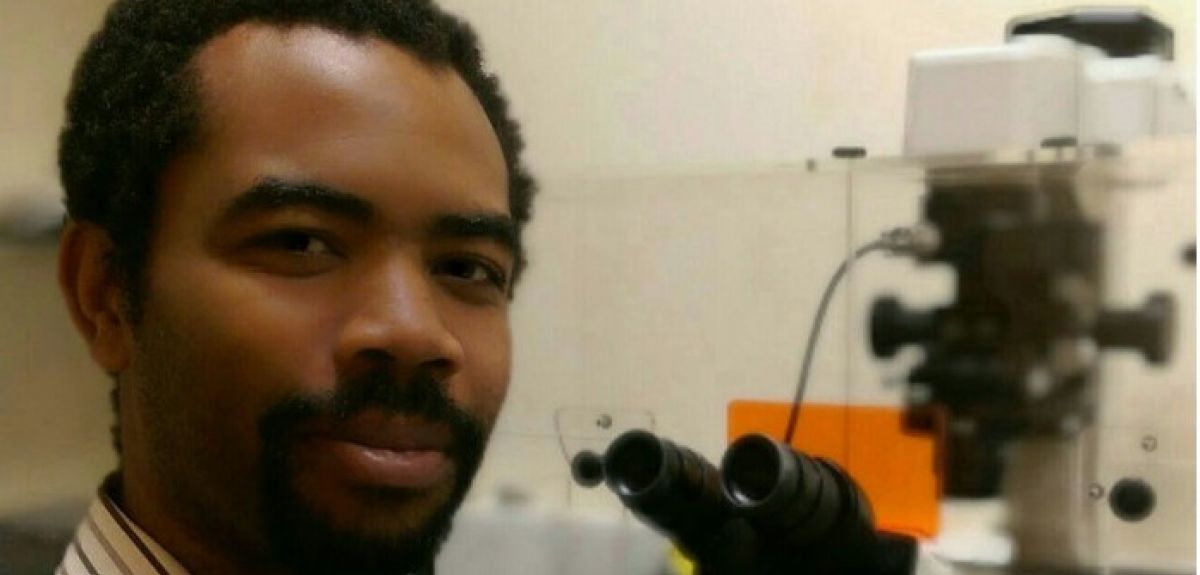
Continuing our series celebrating ‘amazing people at Oxford who you should know about’, ScienceBlog talks to Dayne Beccano-Kelly, an electrophysiologist and a Career Development Fellow in Oxford Parkinson’s Disease Centre, in the department of Physiology, Anatomy and Genetics at Oxford University.
With more than ten years’ experience in the field, Dayne discusses his research using human neurones to improve treatments and the quality of life for people with neurodegenerative conditions such as Parkinson’s disease. He also shares how he is aiming to tackle the lack of BAME leadership opportunities in STEM, by mentoring and inspiring black and minority ethnic scientists of tomorrow.
How would you describe your journey to Oxford?
I am from Cardiff originally, and took my undergraduate degree at Leeds University in bio-chemistry, as a route into medicine. But, after my first year, I changed my mind with a stint in research, as part of my year in industry.
Time and experience showed me that what I really wanted to do was science research, helping people, but being the one to garner the knowledge that would help. It is fun to be continually asking the questions, and driving the conversation on known scientific knowledge.
Was Oxford what you expected it to be?
Oxford is a melting pot of scientific ideas that are often brewing a stone’s throw away, which makes it easier to interact with other scientists and develop collaborations.
I have been here four years now and don’t feel marginalised at Oxford. I expected there to be a low number of BAME academics at Oxford, because there have been at every other institution.
Having lived in Vancouver directly before this, which I loved in a different way, I can feel the contrast. It’s great to be surrounded by so much history. Vancouver is younger than Arsenal FC, my football team.
What motivates you?
By understanding how Parkinson’s Disease works I am helping people every day. As a scientist, and on a personal level, that is one of the best things that we can do.
It is important to remember that there are people waiting for us to get this right. Meeting them patients as I/we do helps to consider them like members of my family. It makes you want to fight for them that little bit harder.
In a nutshell what is neuro electrophysiology?
Neurotransmitters are chemical messages that allow neurones to talk to one another. When received by a neuron the information is changed into and transmitted as an electrical current. It is this combination of chemical and electrical signal that allows us to move, think, talk remember and everything in between. Neurodegenerative disorders affects this communication by causing neurons to degenerate and die. In Parkinson’s disease (PD) it is a specific set of cells that produce a neurotransmitter called dopamine which are under threat. These control goal directed movement and cognition and it is why we see the symptoms we do in PD as these neurones are no longer able to do their job.
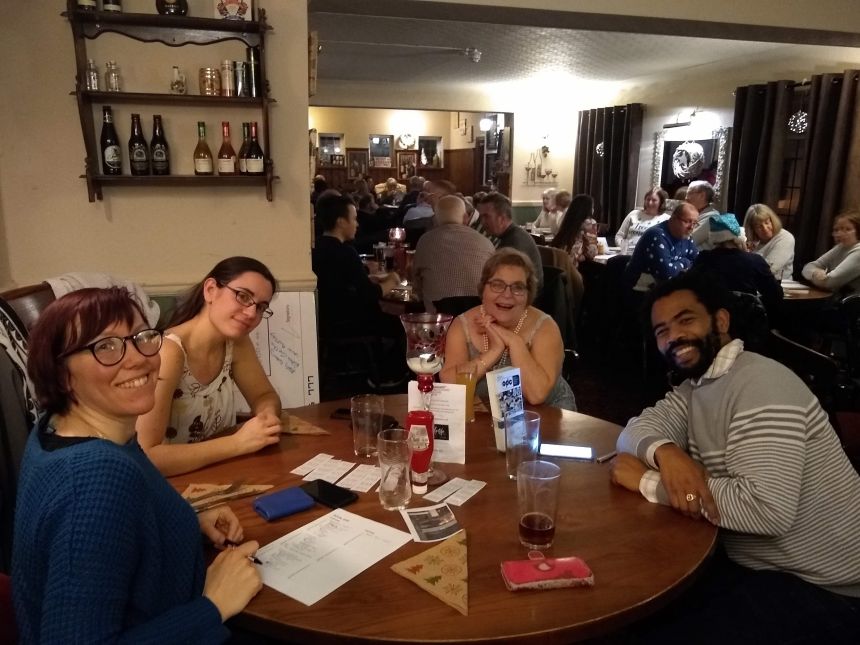 Dayne and his colleagues from the Wade-Martins research group. Image credit: OU
How does your research support care improvements in this area?
My research focuses on converting adult human cells into stem cells, and then converting them into neurones so that we can test for changes in Parkinson’s Disease. The cells that we create are plugged into an open electrical circuit, which we use to measure how neurones talk to each other, via the chemical-electrical signals that I mentioned. I have focused my work on looking at the earliest possible changes we can see in this cross talk between neurones, and what this can tell us about what is going wrong in the condition. If we can understand this, we could begin to think of stopping the disorder in its earliest stages.
In the past this research has been conducted using animal cells, cell lines etc., but this is the first time we are able to use human neurones to investigate human disease in this way. Understanding these cell changes can help us to tailor medicines to better treat the condition.
How did you come to specialise in Parkinson’s research?
As a child I always wanted to be scientist, and naturally wanted to make people better. As a young boy, I apparently stood at the bottom of my arthritic grandfather’s bed, and said ‘I am going to fix you.’ So early on my path was set.
When I was studying at Leeds I was awarded a year in industry at the Mayo Clinic in America, and that sealed the deal. I had a great mentor there, the pathologist Dr. Dennis Dickson. His effervescence and passion for his work rubbed off on me and I just thought ‘man, this is what I want to do.’
My work there focused on Progressive Supranuclear Palsy – an atypical Parkinsonian disorder. I have worked on different neurodegenerative conditions throughout my career at different institutions in various parts of the world, including Scotland, Canada and the US.
What is the most surprising thing you have learned through your research?
As scientists we should just want to know the truth, however, not every scientist sees it that way and that baffles me. I heard a great quote from Prof. Diane Lipscombe at a conference I attended a few weeks ago, she said: “Always follow the data, it will always be more interesting than your imagination can ever generate.” I love that, I think it’s great to generate unexpected things; it’s another question to answer.
I also find it surprising and sad, that I have not encountered more black senior scientists in my career. I find that very jarring.
Has this lack of BAME mentoring opportunities affected your own career?
I’ve been driven enough to get to this stage by myself, but it’s an issue, It would have been nice to have a senior black individual that I could ask, ‘how did you do it? What were the things that you encountered? Was it the same as my experience, or am I just some kind of strange outlier?’
I work with black female and Asian team members, but I am the only black man, and have been in every place I have worked. I very rarely encounter another black male person – sometimes there are postdoctoral students, but they are few and far between.
I am at a point in my career where I want to reach PI level, in order to be a mentor and a leader to the next generation. I love teaching and want to start engaging with people like the British black academics, and teaching groups where there are more opportunities to mentor.
What do you think can be done to change this imbalance?
It is important for young BAME students to see role models as early in life as possible. I want to start programmes that engage them earlier, offer mentoring and introduce them to role models like them, as early as possible.
Many black families who have had senior generations encounter prejudice, preach that you must persevere and you will get a chance to show what you can do. My family was definitely one of those. However, there are a few that sometimes say that certain roles are not for us, and that if you try you will face discrimination. These are in the minority, but it does happen and is very damaging. I want people to see what I am doing, how I am doing it, and see that it isn’t not worthwhile.
What do awareness activities like Black History Month mean to you?
I’ve been really happy to see the University getting more involved in this. People take notice of Oxford, and, from my stand point, the more the University does, it can only be better for everybody.
There are lots of awareness activities throughout the year, a day here, a week here, and I am really glad that it’s a month. Right now we have to do this though, because we have to make people proud. But, you want to reach a stage where dedicating a month to it doesn’t make sense. Why limit it? Let’s celebrate all cultures, all year round.
Are there any things that Oxford as an institution could do to be more inclusive?
Athena Swan was first introduced to create parity in the field for women – as it should be. But, the equivalent (the Race equality Charter) and its awards have far less of a song and dance made about it. I would like to see more effort in this area.
I’m not saying that 50% of professors at Oxford should be black – that would be disproportionate, but there is a disparity between the number of BAME in Britain, and the numbers that enter University, and even more so the attrition of those doing STEM subjects at degree to those doing PhD or higher. It needs to be something that is spoken about more openly, more often and more loudly without shame and actively changed.
If it isn’t, then instead of waiting for it to be the general consensus, why not start the trend here? You’re Oxford. If you are going to use your clout for something, this would be great place to start.
Access in higher education is a very topical issue at the moment, do you have any ideas on what could improve the sector for BAME students
It’s important to keep the dialogue going and make your voice heard. The dialogue for our generation has to be, we need more senior black and Asian scientists.
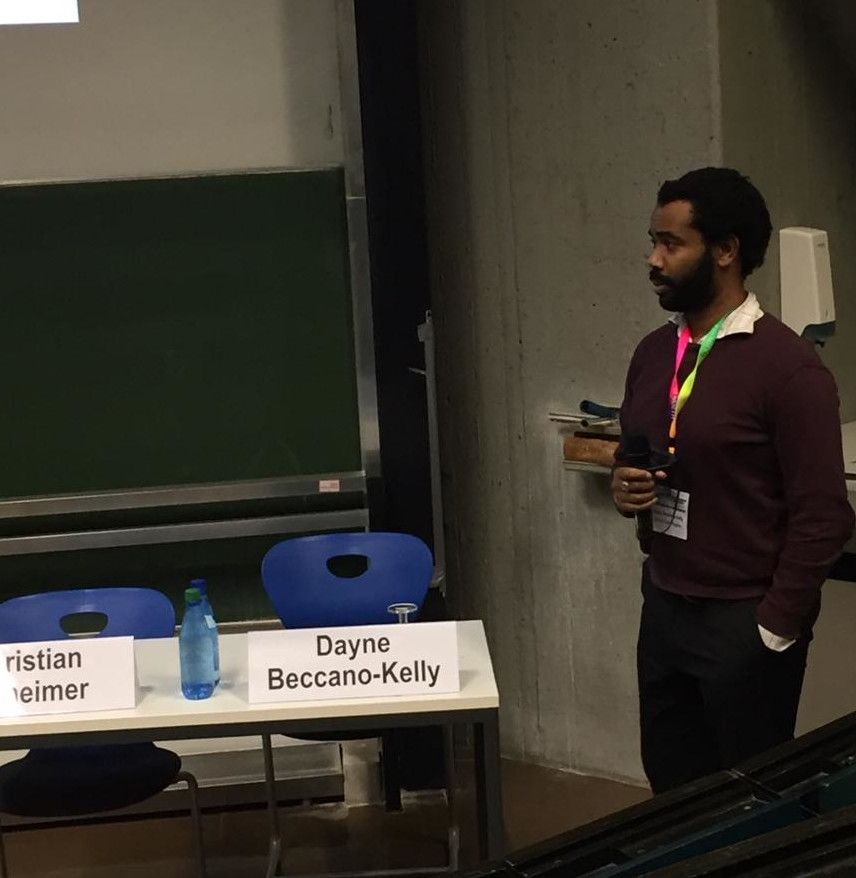 Dayne is a passionate advocate for the power of mentoring, and is keen to work with young BAME pupils, introducing them to academic role models that they can relate to early on in life. Image credit: OU
I was reading about how ‘Stormzy effect’ is driving Cambridge access progress, which is a great message overall. But, it is not tenable to do this across the board. That’s why I am so passionate about encouraging BAME students in academia and doing so from an early age. The more of us there are, the more we can show that we are just as capable as anyone else. Over time there will be a generational shift, and people will just focus on the science, not the colour of your skin.
Has prejudice been a factor in your career?
I have encountered certain prejudices in my career – not at Oxford, but it has happened. People have made flippant comments about my benefiting from positive discrimination, things that shouldn’t be said to me, or to anyone in this decade.
As a black academic, sometimes when you talk about your experiences you get shot down for being over the top, or ‘always’ going on about race. When in actuality, it is the first time you have said anything.
Just because people cannot imagine it, or have not had that experience themselves, does not mean it doesn’t exist. It is a real thing.
Does this experience impact your approach to your work?
My colleagues and friends, would never expect anything less of me because of the colour of my skin. But I am sure there are people that do. I have been told in the street to go home, so I know they exist. I would be remiss if I didn’t have that consideration in my mind to try and change that, so the next generation don’t have to.
Andy Murray openly says that he doesn’t think of Serena Williams as anything more than a great tennis player, and a peer, rather than a female tennis player. That is the stage we have to get to. The task and achievement are the thing that is focussed on, not the gender or the race of the person doing it. It is something that can only come from the previous generation’s battle and fighting for that.
Have these experiences affected you personally?
I would be lying if I said no. Perception and bias are something that we are all prone to. If someone looks at me and makes an assumption, I probably do the same thing. But it is something we have to be aware of and try to make the change.
As a BAME individual you never know if people negatively respond to the colour of your skin, unless they outright say it, but I actively think about how I appear to others.
What motivates you?
I can only thank my family and my mum, for driving me forward. They instilled me with the confidence to succeed which has let me get where I am today. I am their project, they are the scientists.
Some of the stories that they have are just… I’ve experienced stuff, but I have never experienced that stuff. They raised me to always work twice as hard as anyone else, because you have to expect this behaviour, like the recent football game between England and Bulgaria. At times you despair, but I’m not going to lament it.
I just want to get high enough up the chain that I can pull others over the wall with me, if I start to berate and feel sorry for myself, I am not going to get there.
What is next for you?
Currently there is no known cure for any neurodegenerative disease. There are drugs that have been complete game changers, and have helped people to better cope with their disorder for a time. But sometimes medical trials on certain groups fail, and drugs are written off too early I believe.
I want to be involved in pushing forward a dialogue between academia, pharmaceuticals and the medical community. We have to be aware that the drugs we generate may only fit a subset of patients. Just because they don’t work for one group, does not mean they won’t for another.
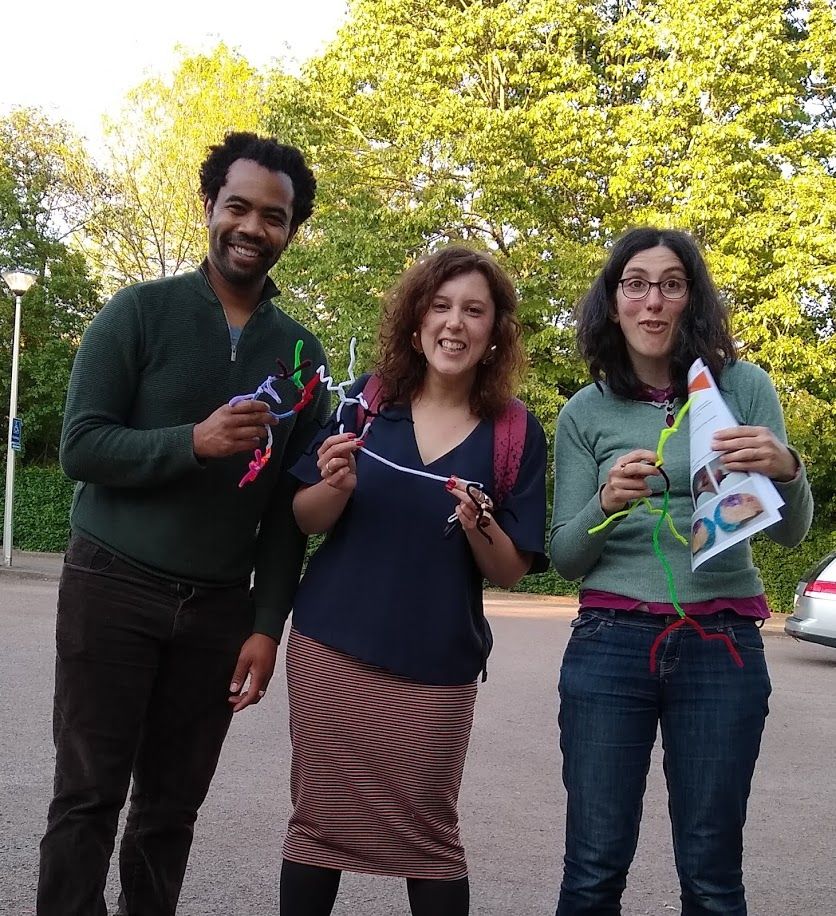 Dayne and colleagues. Image credit: OU
- ‹ previous
- 50 of 252
- next ›
 Setting the agenda for the next century of quantum
 10 years on: The Oxford learning centre making an impact
 Mapping the Moon: the world’s first lunar atlas goes digital
  Oxford and The Brilliant Club: inspiring the next generation of scholars
 New course launched for the next generation of creative translators
 The art of translation – raising the profile of languages in schools
  Opening a window into the quantum world
 Tracking resistance: Mapping the spread of drug-resistant malaria
 Cities for cycling: what is needed beyond good will and cycle paths?