Features

The Oxford Research Centre in the Humanities (TORCH) was officially launched a year ago. Arts Bloglooks back at 12 months of interdisciplinary research, knowledge exchange and thought-provoking public events...
TORCH was launched in May last year with the aim of stimulating, supporting and promoting high-quality humanities research that would transcend disciplinary boundaries and engage with a wider audience. There are now 18 research networks operating with the support of TORCH, covering subjects as diverse as ancient dance, medieval mysticism, the works of Henrik Ibsen and war crimes investigations. That's in addition to eight major programmes including the recent Humanities and the Public Good series of events and the Digital Humanities initiative.
In short, it has been a busy, exciting and successful 12 months for the Radcliffe Humanities-based centre, which was officially opened a year ago at a launch event attended by the Vice-Chancellor.
Among the highlights was the opening night of the Humanities and the Public Good series, which featured a keynote presentation by Earl Lewis, President of the Andrew W. Mellon Foundation, and a round-table discussion on the value of the humanities. The event was the hottest ticket in town on 27 January, with an audience of 450 people packing into Examination Schools (and scores more left disappointed as the venue reached capacity).
The Humanitas Visiting Professor programme also achieved impressive numbers – more than 2,500 people attended the 2013/14 series, which included lectures by the former Archbishop of Canterbury Dr Rowan Williams.
And last month the centre was given a boost with the news it had been awarded more than $560,000 in funding by the Andrew W. Mellon Foundation towards the forthcoming Humanities and Science programme.
Dr Stephen Tuck, Director of TORCH, said: 'We have been somewhat astonished and absolutely delighted by the enthusiasm for TORCH and the high quality, originality and importance of so many new interdisciplinary research projects. Taking advantage of the generous grant from the Andrew W. Mellon Foundation, we look forward to working with colleagues in the social, life and medical sciences in 2014-15.'
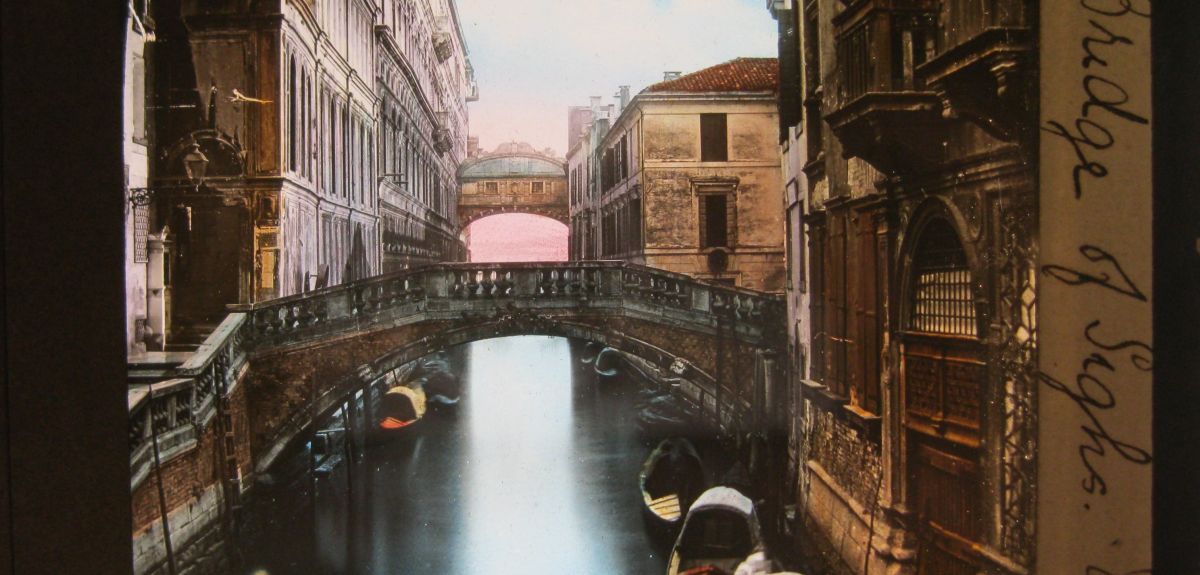
Oxford University's unique collection of Victorian lantern slides will go on show to the public later this year as part of Being Human, the UK's first national festival of the humanities.
The Historic Environment Image Resource, based in the Institute of Archaeology within the University's School of Archaeology, has been awarded funding to host a series of events in November.
Making use of the University's vast collection of late 19th and early 20th-century teaching lantern slides, the events will include a week-long exhibition, a workshop, a citizen science 'tagathon' and an authentic Victorian lantern slide performance.
Known together as 'The shock of the old: glass plate negatives and photographs of late 19th-century England', the events have been made possible by a grant from the festival organisers and the School of Advanced Study, University of London, supported by the Arts and Humanities Research Council and the British Academy.
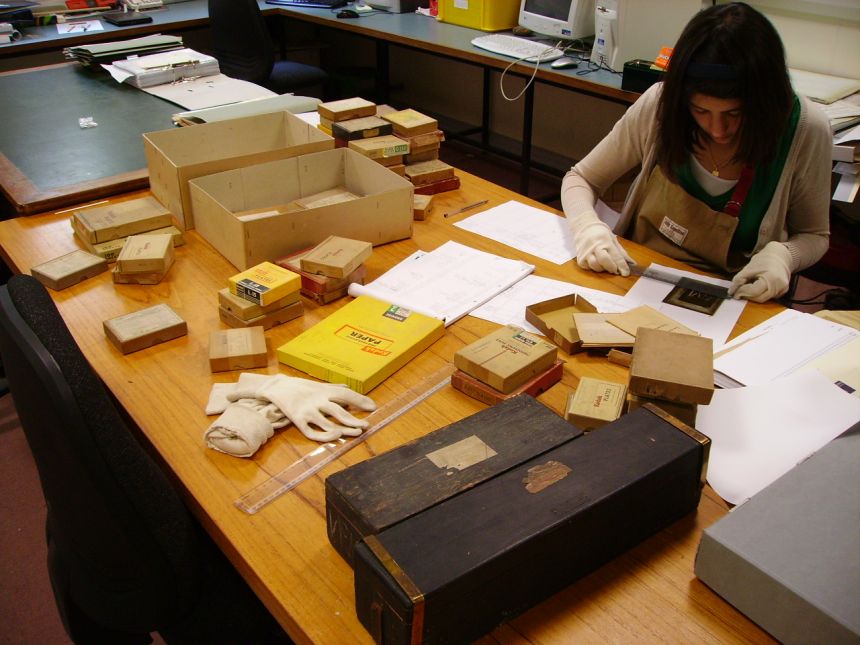 HEIR volunteer Marissa helps sort some of the lantern slides.
Although full details of the events are still to be confirmed, the free public exhibition will be held in a University museum and will feature life-size panels – startling in their detail – highlighting everyday life in Victorian times. The authentic Victorian lecture performance, based on an original 1880s travel series, will recreate a sense of the original excitement and wonder of pre-cinema lantern slide shows by taking the modern audience on a trip through the past, from London to Constantinople, with live musical accompaniment.
The citizen science project will take the form of a 'tagathon' in which volunteers around the world can help enhance the lantern slide resource by tagging the contents of images and using web resources to locate and identify mystery images. The workshop, meanwhile, will be hosted by The Oxford Research Centre in the Humanities (TORCH) and will bring together leading international academics and collaborators to explore ways of exploiting this innovative collection.
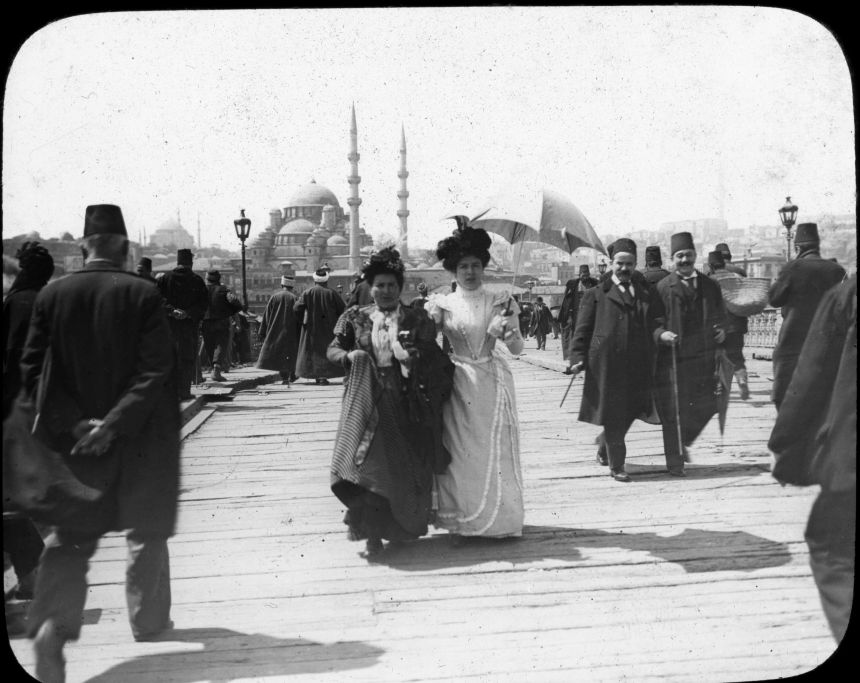 An image of tourists in Istanbul from Oxford University's collection of Victorian lantern slides.
The Being Human festival programme will focus on activities that make humanities research accessible to the general public and demonstrate the role of the humanities in the cultural, intellectual, political and social life of the UK.
Thirty-six grants have been awarded to universities and arts and cultural organisations across the UK to participate in the nine days of festival events taking place across the UK from 15–23 November.
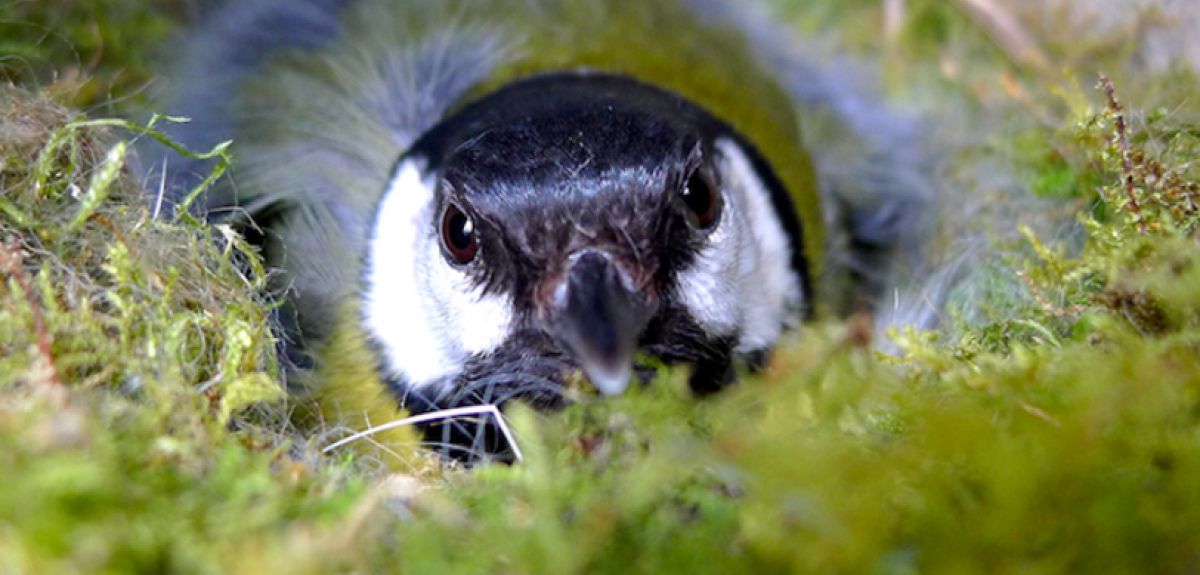
Birds previously identified as having a 'bold' personality return to their nests more rapidly after being faced with a threat than their 'shy' counterparts.
The finding comes from a study of wild great tits in Oxford's Wytham Woods which recorded the responses of 43 female great tits to a simulated threat during the breeding season and then compared the time it took for birds with shy or bold personalities to return to incubate their eggs.
A report of the research, undertaken by Ella Cole of Oxford University's Department of Zoology in collaboration with John Quinn, is published today in Biology Letters. I asked Ella about shy and bold birds, taking risks, and where personality and ecology collide…
OxSciBlog: How do you determine if birds have a 'shy' or 'bold' personality?
Ella Cole: We measure personality by temporarily taking birds into captivity and releasing them into a room containing five artificial trees. We then record how they explore this new space for eight minutes using a handheld computer.
Birds vary considerably in their behaviour in this test, with some bold individuals quickly exploring every corner of the room, and other, more cautious birds staying in one place for the majority of the test. If individuals are tested again, weeks, months or even years later, they tend to behave in a similar way.
Previous work in captivity has shown that great tits that explore more quickly in this test are also more aggressive, less wary of novel objects and more likely to take risks than slower exploring birds. We therefore use this test as a measure of 'boldness'.
OSB: How did you test the link between personality and risk-taking behaviour?
EC: We wanted to measure risk-taking behaviour in the context of reproduction to test whether bold and shy birds differed in the amount of risk they will take to protect their offspring. Birds are very vigilant for any potential threats at their nest which may endanger themselves or their young.
We measured risk-taking by attaching a small black and white flag, representing an unknown threat, to the roof of birds' nestboxes and recording the time it took for females to return to the nest and resume incubating their eggs. We then tested whether the time it took a bird to re-enter the nestbox could be predicted by their personality score.
OSB: What did your experiments reveal about this link?
EC: We found that relatively bold females were quicker than shy birds to resume incubation in the face of perceived risk, with some shy females not returning until the flag was removed. Although it is not known how long these birds would have stayed away if the threat had not been removed, we do know that tits can abandon their breeding attempts completely in response to novelty at the nest.
Our results therefore suggest that shy individuals may prioritise their own survival over that of their offspring, while bold birds do the opposite. These findings support the idea that different personalities may reflect different approaches to life, where bold individuals adopt a 'live fast, die young' strategy, while shy individuals are more cautious and reserve more of their resources for the future.
OSB: Why is understanding birds' personalities important for ecology/conservation?
EC: The existence of animal personalities has wide reaching implications for the study of ecology and evolution. The environment an individual experiences in its life - both in terms of habitat and who it interacts with - is largely determined by its behaviour. Personality has been linked to a wide range of important behavioural traits such as dispersal, habitat choice, social behaviour, feeding, and mate choice.
As a consequence knowledge of personality can help scientist understand how species invade new habitats, how information or diseases spread through groups of animals, the stability and growth rates of populations and ultimately how behaviours evolve. Knowledge of personality even has implications for conservation; in many species personality is related to reproductive success, meaning that conservation breeding programmes can target individuals with certain personality types.
OSB: How do you hope to explore birds' personalities in future research?
EC: One area we hope to explore further is how shy and bold personality types might differ in how they find food in the wild. Work in captivity suggests that shy individuals may be more thorough when searching for food, while bold animals search more quickly but also more superficially. However, very little is known about how personality influences natural foraging behaviour, despite the fact that foraging performance is well known to influence both survival and reproduction, and is therefore a likely mechanism linking personality to fitness.
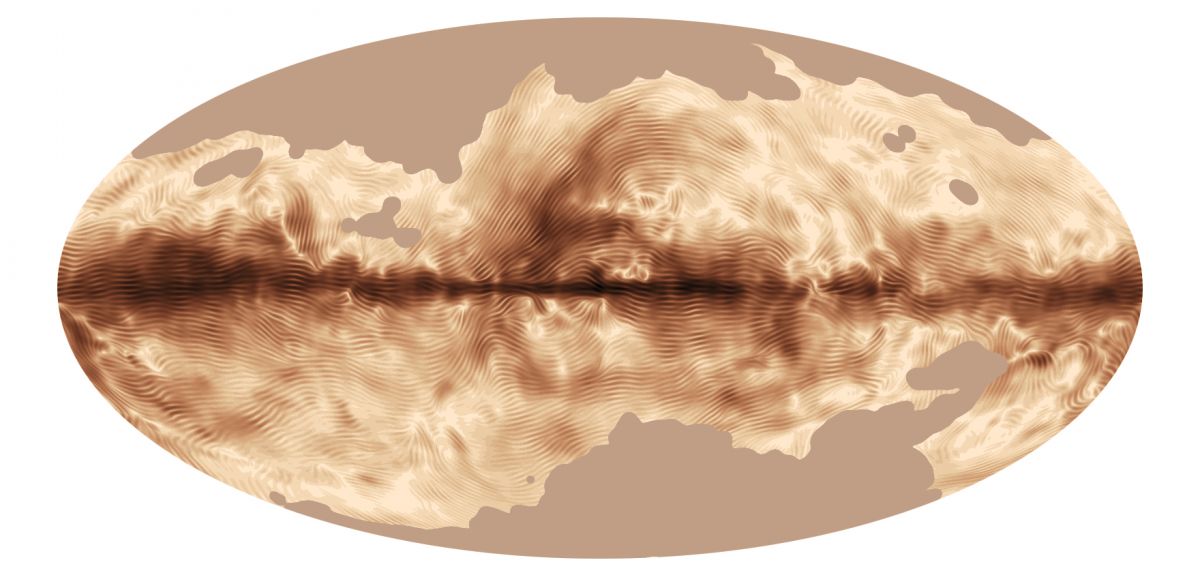
Data from ESA's Planck satellite promises to help us gaze back in time at what the Universe looked like just after the Big Bang.
But between this snapshot of 'ancient light' from the newborn Universe, preserved as an imprint in the Cosmic Microwave Background (CMB), and us lies the foreground of our own Milky Way, which is full of gas and dust that also emits light.
So to test theories about the rapid expansion (inflation) of our Universe, and maybe even spy the primordial gravitational waves - ripples in space time - that should accompany it, we first have to chart our own dusty neighbourhood.
A new map using data from Planck, produced by a collaboration including Oxford scientists, is helping us to do just that. As Joanna Dunkley from Oxford University's Department of Physics explains, it's revealing a lot about the magnetic personality of our galaxy…
OxSciBlog How can light tell us about magnetic fields?
Joanna Dunkley: We don't get to see the magnetic fields directly, but they do affect light that gets sent out by stuff that sits in the magnetic field. In our Galaxy that 'stuff' is mainly relativistic electrons and tiny dust grains.
For the electrons, they emit light while spiralling around magnetic fields. For elongated grains of dust, they prefer to line up with their long side at right-angles to any magnetic field. They are heated up by star-light, and release their heat as infrared light. This comes out preferentially along their long side. So the orientation, or polarisation, of the light, tells you how the dust grains are aligned, which in turn tells you what direction - and how strong - the magnetic field is.
OSB: Why is studying our galaxy’s magnetic field so hard?
JD: There are still huge questions about what our galaxy's magnetic field is. The problem is that we are sitting in our Galaxy, and have to try and construct a 3-dimensional view of the field, but we can only look from here on Earth. We can't get outside the Galaxy to look at the whole thing from different angles.
Parts of the magnetic field are neatly ordered, so in some directions we can see a long way through the Galaxy, but much of it is messy and tangled, and the information in the orientation of the light coming from the dust grains, or the electrons, gets very hard to interpret.
OSB: What does light data reveal about patterns in our galaxy's magnetic field?
JD: The orientation of vibration - or polarisation - of the light tells us what direction the magnetic field lies in. This new map from Planck measures the polarisation of light from dust grains and shows us that the magnetic field is aligned with the disk of the galaxy. It also shows that in some nearby clouds of dust and gas, the field is disorganised, with less ordered polarisation directions.
OSB: How could this data help in the hunt for gravitational waves?
JD: Gravitational waves from inflation also polarize light in the microwave to infrared wavelengths. That light comes from the Big Bang, but we have to separate out the Big Bang-light from the Galaxy-light. Happily the two signals vary differently with wavelength, so if you have maps of the sky at different wavelengths - which Planck does - you can better pull out the tiny signal from the Big Bang. This is something I work on at Oxford with my post-docs, and have developed statistical methods for separating the different signals.
OSB: What are the next big challenges for the Planck team?
JD: One challenge is to delve further into these polarization maps and help test whether the gravitational wave signal recently claimed by the BICEP2 team is really there. We are also currently finishing our second cosmological analysis of the Planck data - using the full set of data taken by the satellite - with results due out later this year.
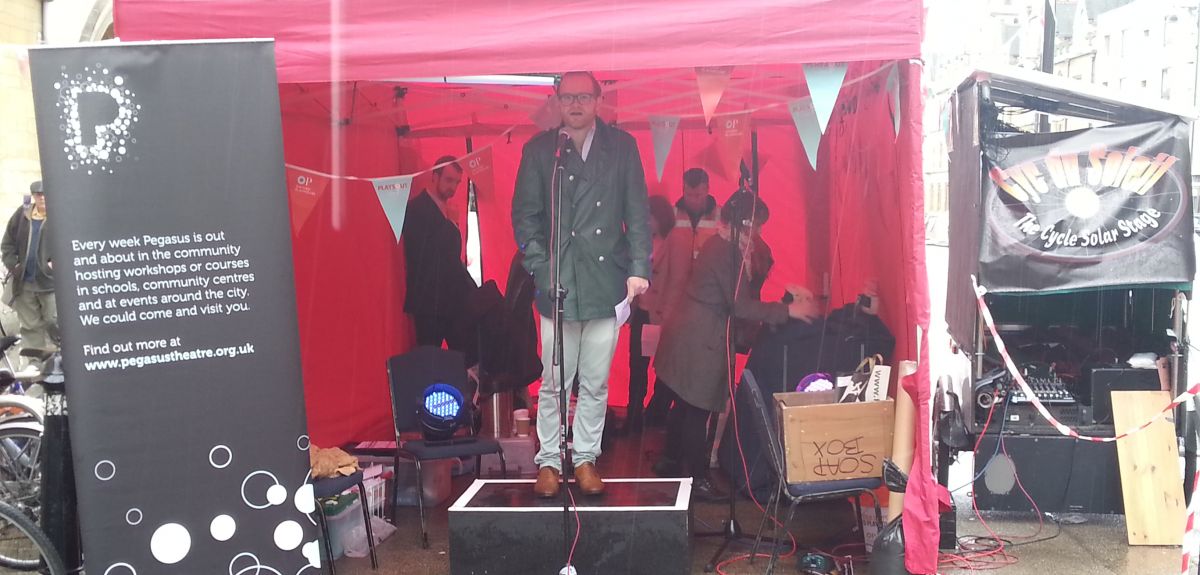
Oxford academics had the chance to get on their soapbox today as part of the city's May Day celebrations.
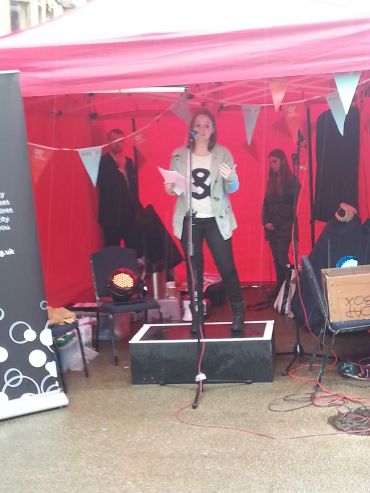 Marchella Ward tells people 'Why Greek Plays Matter'.
Organised by the Oxford Playhouse and Pegasus Theatre, 'Soapbox City' gave the people of Oxford the opportunity to address the Broad Street crowds on a topic of their choice.
The event came with the strapline '1 City, 1 Box, 12 Hours, 144 Voices' and included a 30-minute slot curated by The Oxford Research Centre in the Humanities (TORCH).
Dr Oliver Cox, a Knowledge Exchange Fellow at TORCH, braved the heavy rain to speak on the subject of 'Heritage and Innovation: A Counter-Intuitive Partnership'.
He told Arts Blog: 'It was surprisingly nerve-racking, and it was strange hearing your own voice echo round Broad Street.
'But it was also really exciting to have a platform to say something about the University working together with the local community.
'My message today was "hug a tourist". Tourists are good for us and their money can help sustain and support us.'
Other speakers during an enjoyable and informative half-hour included Jonathan Courtney of the Faculty of Philosophy ('Altruism and Giving What We Can') and Marchella Ward of the Faculty of Classics ('Why Greek Plays Matter').
Also speaking in the TORCH slot were two physicists: Dr Francesca Day, who talked about physics and fan fiction, and Dr Grant Miller, who spoke on the subject of citizen science.
Completing the line-up was Dr Pegram Harrison of the Saïd Business School, whose topic was Antony Gormley's Exeter College statue.
- ‹ previous
- 171 of 253
- next ›
 25-year Oxford study finds the effects of conflict last for generations
 What Louise Thompson’s campaign tells us about the national maternity crisis
 Celebrating 25 Years of Clarendon
  Learning for peace: global governance education at Oxford
  What US intervention could mean for displaced Venezuelans
  Setting the agenda for the next century of quantum
 10 years on: The Oxford learning centre making an impact
 Mapping the Moon: the world’s first lunar atlas goes digital
  Oxford and The Brilliant Club: inspiring the next generation of scholars
 New course launched for the next generation of creative translators