Features

As Associate Professor of Organic Chemistry, a mother of two and one of Oxford University’s most successful entrepreneurs, developing both the spinout companies MuOx and OxStem, Professor Angela Russell wears many hats. She met with ScienceBlog to discuss the progress of women in science in the 21st century, her journey from academia to a successful business woman and her advice to anyone following in her footsteps.
What does your work in Organic Chemistry involve?
I run an academic research group aiming to develop new drugs to treat devastating degenerative diseases like Alzheimer’s and heart failure. The technologies we develop are helping us to answer fundamental clinical questions and understand how different substances affect regeneration processes in the human body. Our work is incredibly rewarding and has the potential to positively impact millions of peoples’ lives.
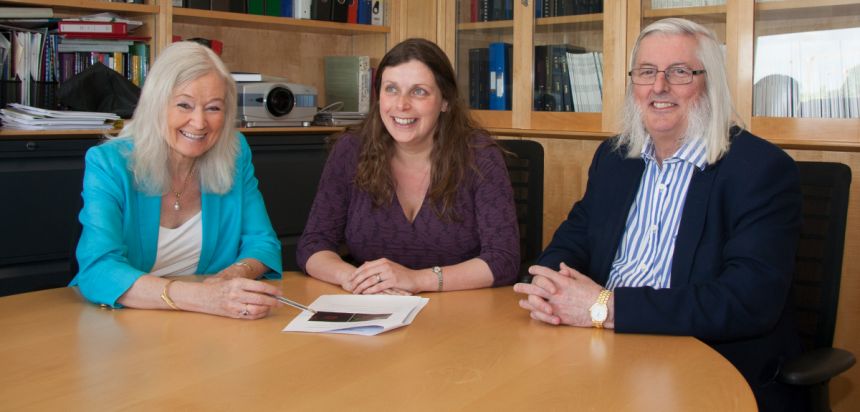 OxStem founders Professor Dame Kay Davies, Professor Angela Russell and Professor Steve Davies
Has becoming an entrepreneur always been a goal for you?
I always thought I would be a pure academic scientist, so the business side of things was totally unexpected. Often when you make a scientific discovery the most exciting part of the project is seeing it applied, but it easy to become removed from the development process in academia, and, it got me thinking why not just do it myself?
How did your journey into science commercialisation evolve?
I have co-founded two successful Biotech companies and both evolved quite organically. Mentorship has been key. Professor Steve Davies in particular has been a huge influence on my career and a co-founder of both MuOx and OxStem. As an entrepreneur himself, he has always encouraged me down the road of the commercialisation of science.
How did you go about commercialising your research and developing a spinout company?
MuOx (Muscle Oxford) built on a longstanding collaboration with Professor Dame Kay Davies, looking for a new treatment for Duchenne Muscular Dystrophy. Our original findings had led to the formation of VASTOx (now Summit Therapeutics plc) who developed the drug ezutromid into clinical trials. We wanted to discover new drugs that could improve on ezutromid’s effectiveness and went back to designing new substances that took the original research to the next level; MuOx.
Often with spinout development selling your product can be a real challenge, but our ongoing relationship with Summit meant they bought us very quickly. The company was spun out in 2012 and bought for five million pounds, by Summit in 2013. We continue to run an extremely important collaborative research programme with Summit developing these new drugs for Duchenne Muscular Dystrophy.
The technologies we develop are helping us to understand how different substances affect regeneration processes in the human body. Our work is incredibly rewarding and has the potential to positively impact millions of peoples’ lives.
What was the biggest learning curve from the development?
Building a strong case for product development that can be easily communicated to anyone - scientists, investors and general public alike is not easy. But if you don’t get it right, you won’t get the investment. As scientists, we get used to talking to each other in scientific code, but it’s just jargon to anyone else. People can’t support or engage with something they don’t understand, so I had to learn quickly how to communicate to people with varying science knowledge, like patients and the general public. You have to build an exciting case and believe in it yourself: ‘not only is this exciting science, but we can deliver on it and change people’s lives.’ If you don’t believe in your product why should anyone else?
How did OxStem evolve?
MuOx proved that we could translate science effectively, and it gave me the confidence to go for it on a big scale with Oxstem, which was effectively MuOx 2.0. It is exactly the same premise, a company developing drugs to treat diseases. But where MuOx focused specifically on muscle degenerative disease, OxStem aims to develop a platform to treat any degenerative or age-related disease.
Was building the company very different the second time around?
Oxstem isn’t a single company, it is an umbrella company, and we spinout successful daughter subsidiaries, each with a different disease focus – four so far. As an academic research development, it has been hard and time consuming to communicate the value of this structure to university stakeholders. We had to outline the structural benefits and challenges, such as how the model could work within existing financial structures, management of intellectual property and so on. It took a long time, but we achieved our goal, and in May 2016 we hit our £17 million target needed to get the company off the ground.
 Professor Russell co-founded OxStem, the company is currently working to develop a regenerative treatment that could reverse the symptoms of Alzheimer's. Photo credit: OXSTEM
Professor Russell co-founded OxStem, the company is currently working to develop a regenerative treatment that could reverse the symptoms of Alzheimer's. Photo credit: OXSTEM
What was the biggest challenge you faced setting up a spinout?
Getting people to believe in your idea in the early stages is really difficult, particularly with funders. Investment is essential to progressing opportunities from lab experiments, to something that will be of benefit to patients in the long run. It takes a lot of time and patience and you have to be up front with people, making sure that they understand what they are getting into. Yes it is a lucrative investment opportunity, but there are risks.
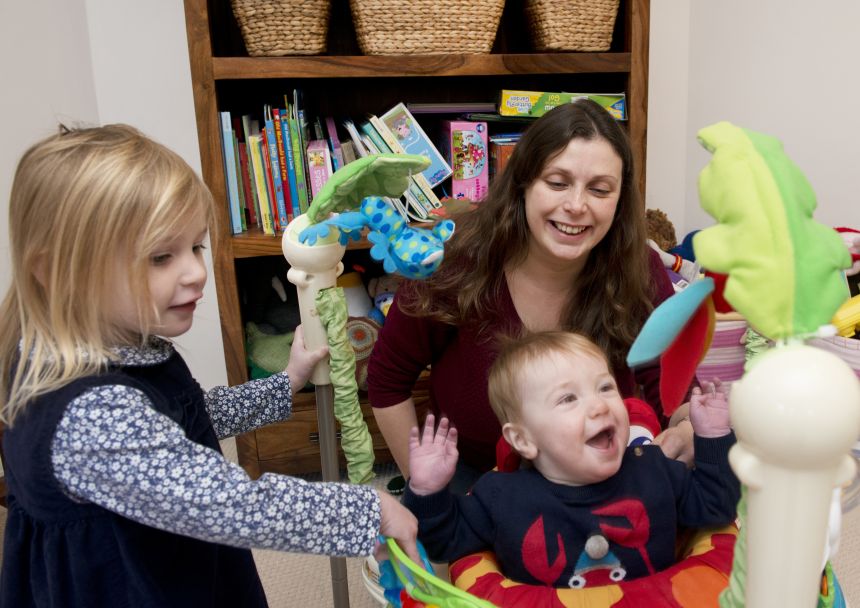 Professor Russell playing with her two children
What advice would you give to someone looking to commercialise their research?
Identify a clear market need for your product, make a clear development plan and a list of reasons why you are the only one that can deliver on it. That is the way to be successful. Being actively involved in progressing your research is so rewarding. If you truly believe in your idea, this is the route for you.
Generally getting government or charity funding for discovery science is straight forward, but doing so for an idea that you want to translate into a research led, spin-out is not so easy; dubbed the “valley of death”. You have to have proof of concept, and show that your idea is going to work.
What projects are you currently working on?
The bulk of my work focuses on the development of new drugs to tackle degenerative and age-related diseases. For instance in collaboration with Professor Francis Szele we are looking at treating diseases like Alzheimer’s and other neurodegenerative conditions and how symptoms can be reversed. A disease like Alzheimer’s is characterised by the progressive loss of neurones in the brain, and we are working to develop a regenerative treatment that will replenish these neurones, reversing the symptoms of the condition in the process. It will make a tremendous difference to people’s lives. If all goes to plan, we will be ready to run a clinical trial in the next three to five years.
You have to build an exciting case for your product, and believe in it yourself. If you don’t believe in it why should anyone else?
Has being a woman in science posed any specific challenges for you?
I have never been discouraged or made to feel that I can’t achieve things because I am a woman. Nor have I ever felt it was an advantage either. I think that is really important. We can’t solve gender bias against women, by deflecting it to men. We have to create an environment where it is better for everybody. I am heavily involved in the Athena SWAN Charter, self-assessment process, and it’s not about creating more opportunities for women, but for everybody, and achieving equality across the board.
How do you think these opportunities can be created?
I think we have to change the working culture, and focus more on valuing people for what they contribute, not how long a day they work. In the past there was a more blinkered view that a brutally long working day was the only way to succeed, which made managing a family and a career almost impossible, but that is changing.
We can’t solve gender bias by deflecting it to men. We have to build an environment that is better for everybody. Not just creating more opportunities for women, but achieving equality across the board.
What motivated you to become a scientist?
My dad was always supportive of my ambitions. When I was 14 he told me ‘you’ll never be happy with a desk job.’ He was right. I’ve always been driven by a desire to carry out research for the betterment of human health. Chemistry was a subject I absolutely loved at school and saw as fundamental to all science because it underpins and impacts so many other disciplines, including medicine.
What advice would you give to someone embarking on a career in STEM?
The decisions that you make at the beginning of your career are important, and can impact your whole future, so try and think long term wherever possible. Everyone makes mistakes, but recognising when you aren’t on the right track and correcting it quickly makes it easier to stay on course. I came to Oxford to study Biochemistry, but realised quickly that it wasn’t for me. Two weeks before my first year exams I told my tutor I wanted to change to Chemistry. I flipped straight into the second year of a Chemistry degree, and almost gave my tutor a heart attack, but it was exactly the right decision for me.
If you hadn’t been a scientist what was your plan B?
I would have been a chef. I actually think chemists and chefs have a lot in common. They experiment with flavour combinations and we scientists cook up drugs that we want to use for clinical use. There is nothing more rewarding than cooking a nice dinner and watching your children tuck in.
 In her spare time Professor Russell enjoys cooking for her family, and has found parallels between chemistry and cooking. Chefs experiment with flavour combinations, while scientists cook up drugs for clinical use. Image credit: SHUTTERSTOCK
In her spare time Professor Russell enjoys cooking for her family, and has found parallels between chemistry and cooking. Chefs experiment with flavour combinations, while scientists cook up drugs for clinical use. Image credit: SHUTTERSTOCK

The annual meeting of China’s legislature, the National People’s Congress, is taking place in Beijing this week. The meeting of China’s national legislature, which runs until March 15, is often seen as a guide for how China’s leadership is thinking.
Rana Mitter, who is Professor of the History and Politics of Modern China and director of the University of Oxford’s China Centre, expects that housing and the environment will be among the main themes of meeting.
‘A lot of the real stuff is done behind the scenes but I would expect certain themes to be spoken about,’ he says. ‘One of those is housing. As in many countries around the world, housing is becoming increasingly expensive for China’s middle class and much of the property growth in China has been fuelled by a boom in credit, which isn’t sustainable, so I’d expect to see some questions about the economy and how housing fits into that.
‘Something else they should also be talking about is the environment. It is well known that China’s cities are now suffering from incredibly bad pollution, the kind of thing that can actually force people not to go outside because they may immediately have a problem with breathing and the Chinese government knows that is not sustainable in the long term, so I hope the NPC will be talking about ways to tackle those issues.’
Professor Mitter also discussed a recent BBC story in which the reporter had his camera damaged and was forced to sign a confession for trying to interview a ‘petitioner’ – that is, someone who visits Beijing to take their grievances to the State Bureau of Letters and Calls because they have been denied justice through their local courts.
Professor Mitter says this heavy-handed response is related to the holding of the National People’s Congress. ‘This is what happens right around major events like this - Beijing goes on lockdown, so it’s disheartening but not entirely surprising to see how swiftly they have cracked down on the petitioners,’ he says. ‘At other times of the year, and particularly outside Beijing at the local level in China, you will see a certain amount more success.
‘There are various mechanisms that the petitioners can use – not just using a letter but also these days using social media and e-government to try and make their complaints known. So while it is patchy and not the same as you would have in a liberal democracy such as the UK, there is a certain amount of permeability in the system to allow complaints to get through.’
He adds that the explosion of the internet in China has made it easier for people to share and request information. ‘One of the great transformations of conversation in China in the last five to ten years has been the growth of the internet,’ he says.
‘One of the reasons it has been so important is that official media is censored strongly so trying to get a story in the People’s Daily, the main Party newspaper, would not be the best way to investigate a story. But the slightly freer media or the media that is attached to some of the very popular video sites that have millions and millions of viewers in China can be an effective way of doing that.’
Professor Mitter was speaking to the BBC’s TV programme, Impact Asia with Mishal Husain.

In a guest blog, Dr Oliver van Hecke, DPhil student in Oxford University’s Nuffield Department of Primary Care Health Sciences and Oxfordshire GP, explains why genetics may determine whether someone experiences multiple chronic diseases.
Chronic pain, depression and heart disease are three of the commonest causes of disability, and are becoming more prevalent in the population. Increasingly, some people will suffer from one or several of these long-term health problems in their lifetime, which is known as multimorbidity, but why? Is this simply down to bad luck or could there be an underlying cause, perhaps due to a shared familial risk, and/or genetic factors?
While we know that age, gender, social circumstances and lifestyle increase someone’s vulnerability to multiple causes of disability, research has now revealed that genetics can indeed play a role in determining whether someone experiences multiple chronic illnesses.
The new study, which we were involved with along with colleagues at the University of Dundee and Kings College, London, examined two major existing population cohorts (Generation Scotland and TwinsUK), for the likelihood of chronic pain, depression and heart disease co-occurring in both individuals and in their siblings. We found that people who had one of these illnesses were much more likely to have one or both of the other illnesses.
Interestingly, we identified a sibling link – the brothers or sisters of people with one of these illnesses were much more likely to have one of the other illnesses too, even after allowing for known social and demographic factors. For example, siblings of people with heart disease were twice as likely to have chronic pain, while siblings of those with depression were twice as likely to suffer from heart disease.
Using the twins data, we were able to show that genetics contributed to the co-occurrence of chronic widespread pain and heart disease in twins, in addition to important environmental contributions.
The finding that genes likely play a key role in determining whether someone experiences multiple chronic illnesses provides researchers new avenues to explore the underlying biological mechanisms between different conditions. Of course, as both a researcher and a clinician I realise it will always be important to address the social and demographic factors that cause disability and comorbidity, such as deprivation for example. However this new insight into the shared genetics of comorbidities may enable us to recognise these conditions earlier in the community. This would, in turn, allow us to focus on preventative therapies for these patients by targeting the underlying causes (such as stress or health inequalities) rather than the visible symptoms of the condition itself.
The full study, ‘Chronic pain, depression and cardiovascular disease linked through a shared genetic predisposition: Analysis of a family-based cohort and twin study,’ can be read in the journal PLOS ONE.

A twice-weekly academic writing group which was set up for PhD students and early career researchers at Oxford University has been credited with boosting productivity and reducing stress.
The group's founder is Dr Alice Kelly, the Harmsworth Postdoctoral Research Fellow at the Rothermere American Institute. In a guest post, she tells the story of the writing group:
'Most people need structure, accountability and discipline if they are to work productively. But this is exactly what disappears when highly qualified, often perfectionistic people start the rewarding but lengthy and lonely PhD process.
This is especially true in the humanities, where, in contrast to the more communal research environment that scientific teams enjoy, study is often solitary. I believe that universities can, and should, do much more to generate a sense of group motivation, camaraderie and peer support among early career scholars in the humanities.
I convene a group of postgraduate students and early career researchers to write together for three hours twice a week. After coffee, I ask everyone to share their goals for the first 75-minute session with their neighbour. Goals must be specific, realistic and communicable, such as writing 250 words or reworking a particularly problematic paragraph. I set an alarm and remind everyone not to check email or social media. When the alarm goes off, everyone checks in with their partner about whether or not they achieved their goal. After a break, we do it again. After our Friday morning sessions, we go for lunch together. And that’s it.
Yet the impact of the group in terms of writing productivity, reducing student stress and promoting a sense of community has been profound – beyond what even I had anticipated when I first introduced these sessions at the interdisciplinary Oxford Research Centre in the Humanities (TORCH) in October 2015. Since its beginning, the group has been enormously popular and is always oversubscribed. I have become convinced that such writing groups are an affordable and highly effective way of reducing early career isolation and improving mental health, and could be implemented more widely.
Participants reported the positive effects in two anonymous surveys for our humanities division. They value the sessions’ imposition of routine, realism about expectations and embodiment of the principle that thinking happens through, not before, writing (known as the “writing as a laboratory” model). Respondents were pleasantly surprised at their own productivity. One said: “I never thought I could accomplish so much in one hour, if I really committed, without interruptions”.
Another said: “It seems I lost the fear of finishing things when I was surrounded by other people.” Participants also reported adopting their newly established good habits outside the sessions.
Most evident, however, was respondents’ improved sense of morale and peer support. One noted that “the PhD can be such an isolating experience; it’s very calming to come to a place where, twice a week, we’re reminded that working independently doesn’t have to mean working alone”. Another referred to the group as “an invaluable resource that should be mandatory for all PhDs”.
The writing group offers, for six hours a week, what most workers get every day: a start time, a stop time and peer pressure not to procrastinate on the internet. Over a term’s worth of attendance, this produces serious results.
One participant had “rewritten a draft thesis chapter, written a conference abstract, edited two reviews for an online publication, finished two book reviews and edited several chapters of a volume”.
My role in the group varies between friend, peer, disciplinarian, mentor, stand-in supervisor, and a regular fixture offering some stability and continuity. If people don’t show up, I hold them accountable. If they are struggling with a piece of writing, I talk them through it.
The group has unexpectedly become an informal forum for all the academic questions we’re not sure who else to ask about, and has therefore had a serious impact on pastoral care through peer support.
As someone who worked long hours through the four years of my PhD – in exhausting periods of “binge writing” and unnecessarily time-consuming revisions – I am now a vocal advocate of short bursts of focused attention and writing as a routine practice, with mandatory time off from academic work.
One survey respondent noted that the group “has given me the sense that I have a working week and am not expected to work 24/7; it has helped me treat my degree as a job”.
As the group has developed, I have investigated strategies to make the sessions more effective. One idea was to organise a manual or sensory activity (colouring in or listening to music, for instance) during the break; another was to make participants set regular goals on index cards and to add a gold star when they achieve them.
Writing marathons – two three-hour sessions, separated by lunch – are useful for meeting end-of-term deadlines. The combination of accountability and reward (group celebrations at the end of a goal period, or when somebody submits their dissertation) motivates participants both to push themselves and to be pleased with their progress.
There is surprisingly little literature on the benefits of writing in group settings. Very helpful texts, such as Eviatar Zerubavel’s The Clockwork Muse (1999) and Paul Silvia’s How to Write a Lot (2007), advocate scheduled writing, goal setting and monitoring progress, but do not address the high levels of self-discipline needed for regular independent writing that a group provides.
Meanwhile, the literature considering writing groups, such as Rowena Murray and Sarah Moore’s The Handbook of Academic Writing (2006) or Claire Aitchison and Cally Guerin’s volume Writing Groups for Doctoral Education and Beyond (2014), promotes them for collaborative writing or peer review purposes, rather than improved morale and community.
Amid mounting demands for “outputs” and increasing evidence of chronic stress and mental health problems among academics, having an academic writing group at every university could be a simple yet powerful way of making the task of writing more productive and rewarding for the next generation of scholars.'
This article was originally published in the Times Higher Education.

The decibel level was raised at a sound-themed event at the Ashmolean Museum on Friday night (3 March).
SUPERSONIC was the latest event in the Museum's popular 'LiveFriday' series, and it involved Oxford University’s Music Faculty, The Oxford Research Centre in the Humanities (TORCH), Oxford Contemporary Music, and Oxford Brookes University’s Sonic Art Research Unit (SARU).
On the night, there were bite-sized lectures from many academics from the University’s Music Faculty, including Professor Eric Clarke.
‘LiveFriday’s ‘Supersonic’ theme was a great opportunity to showcase a whole variety of fascinating activities in and around sound, sound-art and music, involving the Oxford Faculty of Music, Oxford Contemporary Music and other guests and contributors,’ says Professor Clarke.
‘There are no human cultures without music - so music is as defining of what it is to be human as anything else. What better way to explore and acknowledge that fantastic human attribute than by coming to the wonderful Ashmolean Museum, and hearing, seeing and participating in all the musical performances, workshops and talks that will be on offer.’
Professor Clarke told an attentive audience about his new research into the link between music, empathy and cultural understanding. ‘Our research demonstrated that just listening to the music of other cultures can have significant effects on people’s more general cultural attitudes,’ he said.
There were performances from student electronic ensembles such as Sal Para (Tremor Recordings) and Wandering Wires.There were sound art installations throughout the museum, and an interactive songwriting workshop.
Perhaps the most eye-catching part of the event was a ‘swinging’ concert grand piano suspended high above the ground in the Ashmolean’s atrium.
- ‹ previous
- 102 of 252
- next ›
 Setting the agenda for the next century of quantum
 10 years on: The Oxford learning centre making an impact
 Mapping the Moon: the world’s first lunar atlas goes digital
  Oxford and The Brilliant Club: inspiring the next generation of scholars
 New course launched for the next generation of creative translators
 The art of translation – raising the profile of languages in schools
  Opening a window into the quantum world
 Tracking resistance: Mapping the spread of drug-resistant malaria
 Cities for cycling: what is needed beyond good will and cycle paths?