Features

Professor Peter Magill, Deputy Director of the MRC Brain Network Dynamics Unit at the University of Oxford, gives his account of a week of science and policy in Westminster as he began his participation in The Royal Society’s Pairing Scheme.
Once a year, around 30 scientists are paired up with UK parliamentarians and civil servants by the Royal Society, to foster interactions and mutual understanding between researchers and policymakers. Over the ‘Week in Westminster’, the scientists take part in workshops focused on the interface of science with policy, and spend two days shadowing their pair in government. In turn, parliamentarians and civil servants experience the world of research through undertaking reciprocal visits to the scientists’ institutions.
I was fortunate to be given the opportunity to take part in this year’s Scheme. After an introductory tour of the Palace of Westminster on the first day, we got straight down to business in the impressive Portcullis House. After hearing from expert speakers working in academia, learned societies and government, we examined and discussed several topics that are close to many scientists’ hearts; investment in Research & Development, the recent Higher Education and Research Act, and the routes by which researchers can feed into policy making. This was especially well timed, given the publication in November of the Government’s white paper on Industrial Strategy. In just a few hours, we gained some indispensable insights into how science can - and does - inform policy, and vice versa.
On days two and three we visited our pairs at their workplaces. I was paired with Lord James O'Shaughnessy, Parliamentary Under Secretary of State for Health (Lords). I was invited to shadow Lord O'Shaughnessy and his team for many of their daily engagements at the Department of Health, the House of Lords and further afield, including policy briefings, strategy meetings, and a keynote speech. I got to see first-hand the nuts and bolts of Parliamentary business, and how evidence is gathered and used by policymakers to shape their decision making.
I also had the chance to share our own neuroscience research at Oxford, and to explain how we conduct our research, its potential impact on healthcare, and the challenges we have met (and will face in the future). As a memorable conclusion to my shadowing experience, I found myself sitting in on live questions in the chamber at the House of Lords - to see democracy and policy in action and on centre stage was thrilling. I then raced through the Victorian splendour to attend a Mock Select Committee for scientists, another highlight of the week.
The Scheme was rounded off by a morning at the Department for Business, Energy & Industrial Strategy, where we heard from teams at the Government Office for Science, and then had a Q & A session with Professor Chris Whitty, Interim Government Chief Scientific Adviser. What a week!
My time in Westminster was an extraordinary and invaluable experience. It was highly informative and empowering, and - just as important - really enjoyable. I have taken away a fresh perspective on how research findings can help inform the creation, scrutiny and revision of policy, as well as a better understanding of how researchers can get involved in the process. I was also struck by the openness, veracity and multitasking of my hosts working in government. There were many lessons learned in this short period of time, and I have no hesitation in strongly recommending the Pairing Scheme to other scientists and policymakers.
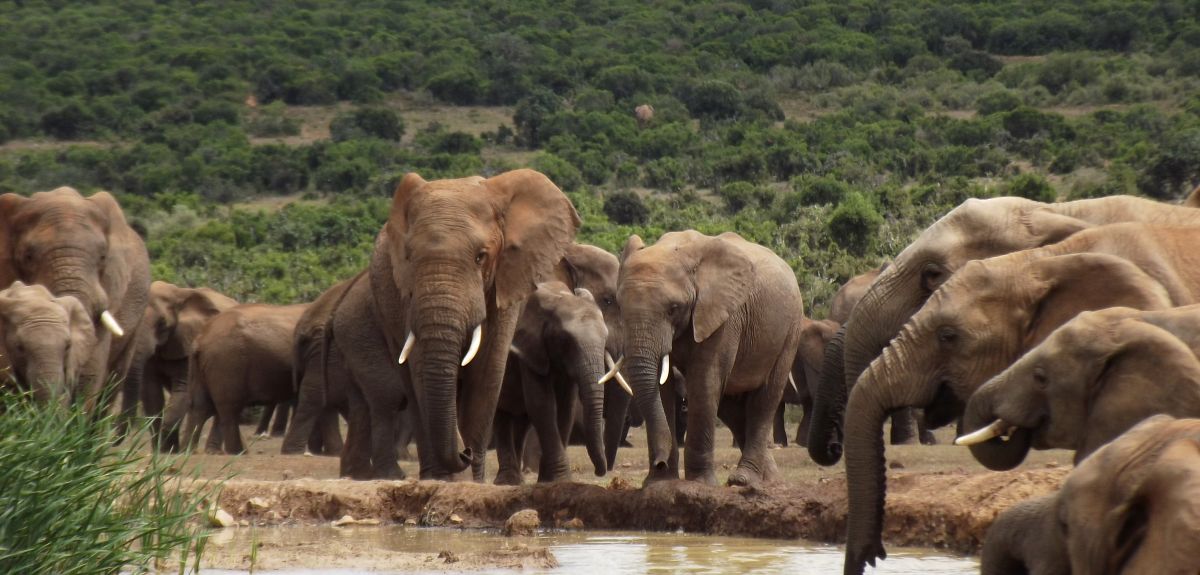
The issue of whether ivory trading should be legalised to fund elephant conservation, or banned altogether, is long standing and widely debated. Both sides of the argument are so contentious that emotional investment can distort our understanding of the core issues.
Hoping to restore some balance to the conversation, Professor EJ Milner-Gulland, Tasso Leventis Professor of Biodiversity in Oxford’s Department of Zoology, outlines both sides of this complex debate. She warns that the continued policy stalemate and intense media interest are inflaming the issue and harming the conservation of iconic, endangered species in the process.
The conservation of wildlife is complex and often contested, particularly when the species concerned is large, charismatic, with monetary value, and whose presence in an area can cause major direct impacts on people's lives. Such is the case for Africa's elephants, but it is true for other species as well, including big cats, large ungulates (hoofed mammals) and wolves. Conflicts over how to manage these species are widespread and challenging to resolve.
In particularly high profile cases, the public debates around these conflicts can become very heated and emotional.
In the case of elephants, heavy poaching in some African countries has caused deep concern for the species' future, and a range of approaches to addressing this poaching has been put forward and strongly championed by different groups. These range from complete trade bans (e.g. Born Free's Bloody Ivory campaign) to limited sales of confiscated ivory (e.g. as proposed in 2016 by Zimbabwe). The confrontational nature of the discourse is clear when observing the media furore that surrounds international meetings where the ivory trade is discussed, particularly the triennial meetings of the Conference of the Parties to the Convention on International Trade in Endangered Species (CITES), the most recent of which was in September 2016. This debate is heavily fuelled and mostly carried out by campaigning conservation organisations. In the heated atmosphere, the underlying values and motivations of those holding different views are questioned, sometimes destructively, and evidence is often interpreted and deployed in a strategic or partisan way.
Issues like elephant poaching for ivory will always rouse an emotional reaction, and rightly so. However the threat from poaching does need to be set within the wider context of issues such as loss of habitat, connectivity, food and water resources, which also threaten the future of African elephants.
This is not helpful either for elephant conservation, or for the governments of countries where elephants live, who are trying to manage their elephant populations under difficult circumstances and with limited resources.
Meanwhile, for more than two decades, African countries have been sharing views with one another and gaining mutual understanding through a series of dialogues. Over the years, supported by CITES, they have worked to develop and adopt two unique and extensive monitoring programmes (Monitoring Illegal Killing of Elephants and the Elephant Trade Information System, MIKE and ETIS) which provide information to CITES Parties about elephant killing and ivory seizures. These two systems, as well as the IUCN SSC African Elephant Specialist Group’s African Elephant Database (AED, where information on the numbers and distribution of African elephants is stored), have provided the information underpinning conservation policy-making. Building on this information, range states worked together to develop and implement the African Elephant Action Plan, which prioritises conservation actions, recognising and respecting the very different circumstances in different parts of the continent.
Despite this huge investment of time and resources into elephant conservation, poaching continues, public concern remains high, and the best way forward is highly contested, particularly in the international media.
An important component of successful conflict negotiation, whether in conservation or other fields (such as national peace processes or climate negotiations) is to hold discussions of the main affected parties away from the glare of the media. such as the African Elephant Range States dialogues. In other fields (particularly fisheries management), these discussions have included the use of formal structured decision-making processes such as Management Strategy Evaluation. These processes go a step further than is currently done in species conservation (including for Africa's elephants).
For elephants, this would start with the agreed goals and priorities of the African Elephant Action Plan. Then researchers would compile and assess all the evidence that exists about elephant poaching and ivory trade, including the existing databases like MIKE, ETIS and the AED, but also local studies of poaching behaviour and consumer demand. This would help us to understand what the uncertainties and knowledge gaps are. Next, this evidence-base can be used to build and test computer simulation models, to explore the conservation outcomes of different potential policy options, at different scales from the local management of Protected Areas in Africa, to initiatives that aim to change consumer preferences in Asian countries. The questions to be addressed would be decided by the African elephant range states, with scientists acting as facilitators and technical support, rather than initiators. When used in this way, structured decision-making processes have already proven to be effective at reducing negotiation times and conflict, and improving conservation and livelihood outcomes, in a variety of contexts. But they have yet to be tried in species conservation.
In a paper published today, my colleagues and I suggest that it would be worth exploring whether following a formal decision-making process would be useful for African elephant conservation. Using these methods could clarify the likely consequences for elephant conservation of contentious policy questions such as the burning of ivory stockpiles, allowing limited legal trade, or closing domestic ivory markets.
It would also clarify where we need to do more research, if we can’t predict the consequences of particular actions based on what we already know.
We also highlight the importance of understanding and respecting the values held by people who see things differently, and recognising that these values may inform the way in which evidence is viewed and interpreted, sometimes subconsciously. Starting from a position of openness and respect for others' dilemmas is an important part of building trust and moving any debate onto a more constructive footing. This message is aimed more at campaigning international conservation organisations than at those already engaged in elephant management on the ground, who are generally well aware of the challenges and trade-offs inherent in real-world conservation.
Issues like elephant poaching for ivory will always rouse an emotional reaction, and rightly so. However the threat from poaching does need to be set within the wider context of issues such as loss of habitat, connectivity, food and water resources, which also threaten the future of African elephants.
Donors need to continue to support dialogue among the range states and the further development of databases such as MIKE, ETIS and the African Elephant Database. They need to also support efforts to better forecast and plan in an era of rapid land transformation and resulting habitat loss across Africa. With the added elements we suggest in our paper, we hope the unconstructive public debates which rage around the issue could be dampened down. This would ultimately benefit the conservation of Africa's elephants. Most species do not attract the huge media attention that elephants do, but they too could benefit from the approaches we lay out in our paper. These are already well-used in other fields (like fisheries management and climate change) where similarly difficult decisions need to be made, despite not having all the facts, and where the people involved may have very different perspectives and interests.

Professor Chas Bountra, Co-Director of the Oxford Martin Programme on Affordable Medicines and Chief Scientist at the Structural Genomics Consortium, explains why a new approach to drug discovery and development is needed to address the urgent need for new drugs.
Pharmaceutical research and development (R&D) is one of the best examples of human ingenuity. It attracts vast amounts of funding, employs brilliant minds, and deploys the most advanced technologies. Over the past century, it has enabled unprecedented advances for human health.
Yet the pharmaceutical R&D system is struggling to keep up with society’s medical needs. High failure rates and prolonged research timelines for candidate drugs constitute a human tragedy, and have dramatically increased the cost of drug discovery over the last decades.
More and better medicines are desperately needed at a time of global ageing and expanding populations, with new challenges such as antibiotic resistance on the horizon and many tropical infectious diseases still in need of adequate pharmaceutical solutions. To meet these challenges it is imperative that we rethink drug discovery.
In a new study, ‘A New Pharmaceutical Commons: Transforming Drug Discovery’, I and my colleagues, Dr Wen Hwa Lee, and Dr Javier Lezaun, call for ‘open science’ approaches to drug discovery and offer ways forward that would transform how the medical challenges of this century could be addressed more efficiently.
Our research highlights the limits of traditional R&D models focussed on secrecy and the protection of Intellectual Property (IP) rights, and offers a set of recommendations for strengthening pre-competitive and open source practices that can accelerate the race for cures to the world’s most harmful diseases.
The pharmaceutical industry has made enormous strides in the production of potential therapies and medicines. But even today, close to 90% of candidate drugs that enter Phase 1 trials fail to make it to the market place. This is a system beset by duplication of effort and hence wastage of resources. No one lab or institution can do this on its own. We must urgently pool resources and expertise, minimise duplication, explore new drug targets, biomarkers, and technologies in order to generate new, effective, and more affordable drugs for patients more quickly.
The new paper calls for the adoption of ‘open science’ principles that would allow for a less restrictive approach to the sharing of pharmaceutical tools and data, and would re-define the role of IP in pharmaceutical R&D. It also gives examples of where this is already working successfully.
There has been a great deal of successful experimentation with the application of pre-competitive and open source approaches to drug discovery, not least here at Oxford with the Structural Genomics Consortium, which has shown how corporate pharmaceutical resources can be pooled and used to produce IP-free science.
Our study identified a number of ways in which the world of drug discovery can be enlarged and strengthened, including:
- tax incentives for pre-competitive and open source research, for example by introducing a lower tax rate on profits obtained from IP-free innovations, or to facilitate the placing of patented innovations in free-access platforms.
- the introduction by regulatory agencies of specific designation for products developed through open science collaborations, with reduced fees and fast-tracked review of technical data.
- the development of new evaluative metrics by pharmaceutical companies to better capture the value of open science research, and create schemes that allow researchers to contribute a percentage of their time to open science drug discovery initiatives.
- a shift away from patent- and intellectual property-centric measures of performance within academia.
- increased investment in open science drug discovery initiatives by research funding bodies, to develop specific funding programmes to kick-start these efforts and place the supporting infrastructures on more sustainable footing.
Although there is no simple one-size-fits-all solution to the challenges of the drug discovery process, open source R&D has the potential to have a significant impact.
The full paper, ‘A New Pharmaceutical Commons: Transforming Drug Discovery’, can be read on the Oxford Martin School website.

This is the latest in the Artistic Licence series.
Louisa Olufsen Layne loves literature. She also loves reggae.
Growing up in Norway, she devoured Dostoyevsky and soaked up her Dad’s record collection. Now, at Oxford, Louisa is bringing her interests together.
Louisa is a fourth-year DPhil student studying English. Talking about her love for literary theory and her ear for Jamaican music, she explains how a desire to combine the two brought her to Oxford.
“I thought there was something compelling about bringing those two worlds together,” she explains.
The poet Linton Kwesi Johnson turned out to be the key. Johnson is well-known for developing dub poetry, a genre heavily influenced by reggae music.
Primarily active in the 1970s and 1980s, Johnson developed a style of poetry that crosses the boundary between poetry and performance. He also toured with punk performer John Cooper Clarke.
Louisa was fascinated by Johnson, and after studying his poetry for her master’s degree in Oslo, she knew she wasn’t finished with him.
'I liked the UK, I liked the university culture, and I met some people who had gone to Oxford,' Louisa remembers. 'They said I should consider applying here. So I did!'
Louisa has now spent the past four years working on Linton Kwesi Johnson’s poetry and making the most of what Oxford has to offer.
Coming to Oxford as an international student and a graduate was a big change for Louisa. 'When you change institutions, you start to see things quite differently,' she says. 'Oxford gave me much more of a historical interest.'
On the personal side, adjusting was a little more challenging. 'When I first came here, I didn’t know anyone, so I was quite shy,' she admits. 'The first seminars I went to, I felt quite intimidated.
'But then you get used to the environment. I started to feel more confident in this new place, and all of a sudden, people go from being strangers to becoming your friends.'
The postcolonial seminar in the English Faculty gave Louisa her first tastes of home in Oxford. “The postcolonial seminar has really been kind of like a home here,” she says.
Attending the seminar brought Louisa to a community of people working on topics ranging from black British writing to Caribbean and World literature. Inspired by the conversations taking place, Louisa decided to get involved in organisation herself. Last year, she began co-convening the Race and Resistance network at TORCH.
This proved to be an exciting move. In February, Louisa organised an event on hiphop for the network with her colleague Dr. Imaobong Umoren.
“Marcyliena Morgan, the director of the Hiphop Archive and Research Institute at Harvard, came to talk about the study of hiphop,” she says. “For me, that was one of the highlights.”
During the event, Morgan talked about how British and American scholars can research and exchange knowledge not only on hiphop, but also on British rap and grime, and other forms of contemporary culture.
'It added an interesting perspective,' Louisa says. 'Marcyliena Morgan was talking about how they’ve had hip-hop fellows, and have an archive of the best hip-hop albums. Oxford is very good at historical topics and disciplines, and should continue being so, but we also have room for contemporary culture and criticism.'
So while bringing together her love of literature and music, Louisa has made some pit stops along the way—delving into hiphop, African-American literature, and punk lyrics. It’s these opportunities to explore such diverse areas that Louisa has relished while at Oxford.
'There’s so many things going on, so if you get involved, like I did, it opens up possibilities,' she says.

This is the latest in the Artistic Licence series.
Since the first films emerged in the 1890s, in societies of all eras, sizes, and ideologies, movies have had us enraptured.
And Catriona Kelly, Professor of Russian at New College, is exploring how one Soviet film studio has contributed to this long and colourful world of cinema - both on- and off-screen.
Lenfilm, a film studio based in Leningrad, was the second-largest production company in the Soviet Union, after Mosfilm, the Moscow studio. At its height in the 1960s and early 1970s, when a cluster of young filmmakers began making adventurous new movies, it produced up to fifty films a year.
These ranged from The Amphibian Man (1962), a science fiction movie about a man with shark gills, to A Boy and a Girl (1966), a film about two young people’s holiday relationship that was banned immediately after its release.
Through archive material and oral history interviews, Professor Kelly is using Lenfilm, which was a vast film factory with over 4,000 employees, as a window onto life in the USSR.
While amphibian-like men swam around onscreen, Lenfilm employees were working collectively on the film-making process, dealing with budgets, equipment supply, and censorship. Exploring how the organisation worked gives us an unusual angle on the role of the Communist Party in the Soviet Union.
“The Party wasn’t just an ideological censor. It was the only management structure that united the whole studio, from location to wigs and makeup. When it disappeared, the studio fell apart,” Professor Kelly says.
Looking at the institutional history has also thrown up some examples of more familiar, Hollywood-esque problems, like people getting drunk in the film processing laboratories, or storming off set because the director swore at them.
But despite the occasional angry outburst, Lenfilm produced many successful films. These included crowd pleasers like the all-singing, all-dancing Wedding in Malinovka, a comedy operetta set during the Russian Civil War, but also films that were more serious or experimental in tone, such as Aleksei German’s My Friend Ivan Lapshin (1984).
“The films were often characterised by a quasi-documentary, neorealist approach to Soviet society, and some of them were quite hard-hitting,” Professor Kelly says.
One of her favourites is Gennady Shpalikov’s A Long Happy Life (1967), a love story about a man who hitches a lift on a passing coach and a woman he meets on it.
At the peak of their popularity, hit films like Amphibian Man were watched by up to 100 million people. Some, like Grigory Kozintsev’s Hamlet and King Lear, or, more surprisingly, Sergei Mikaelyan’s Bonus (1975), about workers in a Soviet factory, garnered appreciative audiences and prestigious prizes across the Soviet Union and abroad.
In the early 1970s, audience numbers began to drop, but films remained popular—and some of them still are. “TV reduced audiences in cinemas, but people also avidly watched films on TV. Indeed, they still do, and popular Soviet films are widely watched on YouTube,” Professor Kelly says.
Professor Kelly has first-hand experience of this appetite for Soviet films. Throughout her research project on Lenfilm, she has shown some of the studio’s films to audiences in Oxford, and even hosted some Lenfilm directors in the city.
“These events are popular with members of the public - they’re interested in seeing something they can’t see in a commercial cinema,” she says. So far, they’ve had visits from Konstantin Lopushansky, Vitaly Melnikov and Yuly Fait, and are planning more showings for the upcoming year, which is the centenary of the Russian Revolution.
As well as offering an insight into the history of the USSR, Professor Kelly thinks that production studios like Lenfilm have an important impact on Russia today. “Film was an enduring part of popular culture,” she says.
Curious? Watch Wedding in Malinovka for yourself here.
- ‹ previous
- 84 of 252
- next ›
 Setting the agenda for the next century of quantum
 10 years on: The Oxford learning centre making an impact
 Mapping the Moon: the world’s first lunar atlas goes digital
  Oxford and The Brilliant Club: inspiring the next generation of scholars
 New course launched for the next generation of creative translators
 The art of translation – raising the profile of languages in schools
  Opening a window into the quantum world
 Tracking resistance: Mapping the spread of drug-resistant malaria
 Cities for cycling: what is needed beyond good will and cycle paths?