
Four Oxford researchers honoured in the Royal Astronomical Society’s 2026 Awards.
Four Oxford University academics have been honoured in the Royal Astronomical Society (RAS)’s 2026 Awards, announced today. Each year the RAS Awards recognise significant achievements in the fields of astronomy and geophysics, encompassing different types of talent from research to education and outreach.
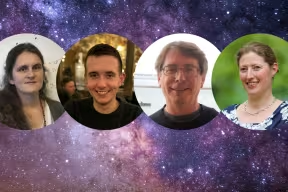

About the Oxford winners:
Professor Suzanne Aigrain (Department of Physics) – Awarded the George Darwin Lectureship
I am delighted and honoured to receive this award, which recognises both my research and my commitment to communicating it to a variety of audiences, something I very much enjoy. In the next decade, we hope to find habitable planets in the Solar neighbourhood, paving the way to searching for signs of life in their atmospheres, but only if we can achieve the exquisite sensitivity required.
Professor Suzanne Aigrain (Department of Physics)
Professor Aigrain’s research focuses on detecting and characterising exoplanets (planets orbiting stars beyond our Sun), particularly those that could potentially host life. A major challenge in studying these planets is the natural variability of their host stars, which can obscure the subtle effects planets have on the star’s apparent brightness and motion through space, that allow us to detect them indirectly.
Professor Aigrain is an internationally recognised expert in modelling this variability and disentangling it from planetary signals. Over the last 25 years, she has played a key role in surveys that have discovered thousands of exoplanets, and developed methods that are widely used in the community. Looking ahead, she is strongly involved in two major projects aiming to find Earth-like planets: the European Space Agency’s PLATO mission and the UK-led Terra Hunting Experiment.
She is a dedicated science communicator, committed to scientific outreach (including her 2024 TEDx talk), citizen science (through the Planet Hunters TESS project), as well as fostering best practice in astronomical data analysis.
Dr Deaglan Bartlett (Department of Physics) – Awarded the Early Career Award (Astronomy)
I am very grateful to the RAS for this recognition. I have benefited greatly from the insights and support of my many collaborators in developing new theoretical and computational tools to extract insight from increasingly complex cosmological data. I am fortunate to work at a time when advances in data, computation and methodology are transforming cosmology, and it is a privilege to contribute to this progress.
Dr Deaglan Bartlett (Department of Physics)
Dr Bartlett focuses on developing statistical and machine learning methods for cosmology and astrophysics. This includes building high-performance machine learning models capable of analysing the latest highly-detailed surveys of the Universe.
A central focus of his research is symbolic regression (SR), a method that automatically discovers mathematical equations directly from data. Unlike deep neural networks, SR produces simple, understandable expressions that reveal the underlying structure of a system, extrapolate reliably, and run orders of magnitude faster. Dr Bartlett develops new SR techniques that combine statistical methods and machine learning to build symbolic models that achieve the accuracy of neural networks whilst being transparent and easy to use across different scientific applications.
Much of Dr Bartlett’s research is carried out within large international collaborations using machine learning to speed up and improve computer simulations of the Universe. These advances will make it possible to fully exploit upcoming galaxy surveys to probe the nature of dark matter, dark energy, and the formation of structure in the Universe.
Professor Andrew Bunker (Department of Physics) – Awarded the Herschel Medal, which honours investigations of outstanding merit in observational astrophysics.
I am greatly honoured to receive the Herschel Medal. It has been very exciting to work on incredible data from the James Webb Space Telescope and help discover some of the most distant galaxies yet. The sensitivity of the near-infrared spectrograph NIRSpec has been revolutionary, and I warmly acknowledge the contributions of my fellow members of the Instrument Science Team.
Professor Andrew Bunker (Department of Physics)
Professor Bunker researches galaxy formation and evolution, and searches for the most distant galaxies yet known. These galaxies formed so long ago that the light we see from them has been travelling for most of the age of the Universe (13.7 billion years) to reach us. By discovering galaxies formed when the Universe was very young and comparing them with more nearby galaxies formed when the Universe was older, we can study the formation and evolution of galaxies: an astronomical version of archaeology.
Over his career, Professor Bunker has used the Hubble Space Telescope and large ground-based telescopes to study these galaxies, and led the first scientific paper on the Hubble Ultra Deep Field - the most sensitive image of the cosmos ever taken. More recently, he has worked on the near-infrared spectrograph NIRSpec on the James Webb Space Telescope, an instrument which has been revolutionary in its sensitivity, enabling the discovery of some of the most distant galaxies yet and new insight into the rate at which stars are born.
Associate Professor Paula Koelemeijer (Department of Earth Sciences) - Awarded the Fowler Award (Geophysics)
It is a real honour to receive the Fowler Award from the Royal Astronomical Society. I feel fortunate that my passion for unravelling signals hidden in seismic data is being recognised and I am proud to represent the geophysics community with this award. It is not just a reflection of my work, but also acknowledges a large group of people I have had the pleasure of working with.
Associate Professor Paula Koelemeijer (Department of Earth Sciences)
As a seismologist, Professor Koelemeijer uses seismic waves to understand the world around us. Her research encompasses a diverse range of applications of seismology, ranging from global tomography to image deep Earth structure, to seismic noise for studying human and animal behaviour. She is renowned for her expertise in normal modes, some of the most complex seismic signals used to probe Earth’s interior. Recently, her research has revealed the evolutionary history of two continent-sized structures in the deep mantle and detailed how a landslide-induced tsunami shook the Earth for days. Her current research focuses on robustly imaging 3D structures inside the Earth using novel methods that allow us to quantify model resolution and uncertainties.
Alongside her research, Professor Koelemeijer is a dedicated supervisor of both masters and DPhil students and teaches a variety of geophysics courses to undergraduates. She is also an avid supporter of outreach and public engagement, making use of 3D printing to develop inclusive outreach materials.
Further information about the Royal Astronomical Society’s 2026 Awards can be found on the society’s website.
For more information about this story or republishing this content, please contact [email protected]


