
Pressure flips the switch on cancer cells
A new study published in Nature reveals that the mechanical environment surrounding a tumour can cause cancer cells to change their behaviour, triggering a switch from rapid growth to a more invasive, drug-resistant state.
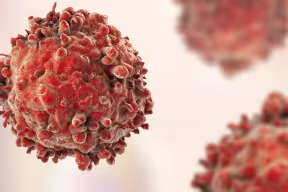

Cancer cells are notoriously flexible, and take on new features as they move around the body. Many of these changes are due to epigenetic modifications - the way DNA is packaged - and not due to mutations in the DNA itself. These modifications are difficult to target because they are reversible, and can flip on and off.
Traditionally, epigenetic changes have been thought to arise from internal cellular processes, such as histone methylation or DNA acetylation, or from biochemical signals like growth factors or metabolites within the tumour microenvironment. But in a new study led by Miranda Hunter (Memorial Sloan Kettering Cancer Center) and Ludwig Oxford’s Richard White, we now know that the physical environment in which these cells land is a key instigator.
Using a zebrafish model of melanoma, the authors show that when tumour cells are tightly confined by surrounding tissues, they undergo structural and functional changes. Rather than continuing to divide rapidly, the cells activate a program of ‘neuronal invasion’, enabling them to migrate and spread into the surrounding tissue.
At the centre of this transformation is HMGB2: a DNA-bending protein. The study demonstrates that HMGB2 responds to the mechanical stress of confinement by binding to chromatin, altering how genetic material is packaged. This exposes regions of the genome linked to invasiveness. As a result, cells with high levels of HMGB2 become less proliferative but more invasive and resistant to treatment.
The team also found that melanoma cells adapt to this external pressure by remodelling their internal skeleton, forming a cage-like structure around the nucleus. This protective shield involves the LINC complex, a molecular bridge that connects the cell’s skeleton to the nuclear envelope, helping to protect the nucleus from rupture and DNA damage caused by confinement-induced stress.
Richard White, Professor of Genetics at Oxford's Ludwig Cancer Research, and lead author, said: 'Cancer cells can rapidly switch between different states, depending on cues within their environment. Our study has shown that this switch can be triggered by mechanical forces within the tumour microenvironment. This flexibility poses a major challenge for treatment, as therapies targeting rapidly dividing cells may miss those that have transitioned to an invasive, drug-resistant phenotype. By identifying the factors that are involved in this switch, we hope to able to develop therapies that prevent or even reverse the invasive transformation.'
The findings highlight the role of the tumour microenvironment in shaping cancer cell behaviour, showing how physical cues can drive cells to reorganise their cytoskeleton, nucleus and chromatin architecture in order to shift between states of growth and invasion. Crucially, the study also demonstrates how physical stress can act as a potent and underappreciated driver of epigenetic change.
The full paper, ‘Mechanical confinement governs phenotypic plasticity in melanoma', is published in Nature.


