
MSc in Mathematical Modelling and Scientific Computing
The MSc in Mathematical Modelling and Scientific Computing is a one-year master's course providing training in the application of mathematics to a wide range of problems in science and technology.
Full time
Closed to applications for entry in 2026-27. Register to receive an email when applications open (for entry in 2027-28).
- Expected length
- 12 months
- Expected start date
- October 2026
- English language level
- Higher level required
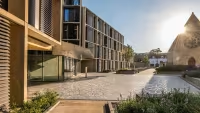
The Mathematical Institute (University of Oxford Images / John Cairns Photography)

About the course
The course places emphasis on the formulation of problems, on the analytical and numerical techniques for a solution, and the computation of useful results.
The intended learning outcomes of the MSc in Mathematical Modelling and Scientific Computing are to gain knowledge of
- core methods of applied mathematics and numerical analysis;
- computer programming of mathematical algorithms;
- mathematical modelling;
- more advanced topics in modelling, methods and numerical analysis;
- how to undertake a short research project in an area of applied mathematics; and
- how to communicate mathematics effectively, both orally and in written form.
Course structure
The course consists of both taught courses and a dissertation.
To complete the course, you must complete 12 units. You will accumulate four units in core courses, two units in special topics, two units in case studies and four units in the dissertation. In addition, you will usually attend classes in practical numerical analysis and additional skills during Michaelmas term and in mathematical modelling during Hilary term.
Each core courses consists of 16 lectures, classes, and a written examination.
In the first term (Michaelmas term), you should expect your weekly schedule to consist of 4-6 hours of core course lectures and 2-3 hours of practical numerical analysis or scientific computing case study classes and additional skills classes, then a further two hours of lectures for each special topic course followed. In addition, there are around three hours of classes for the core courses and special topics, and you should expect to spend time working through the associated problem sheets prior to each class. There are similar contact hours in the second term (Hilary term), and there will be revision classes and exams during the third term (Trinity term).
The expectation is that you will spend the beginning and end of the third term as well as the long vacation working on your dissertation. During this time, you should expect to work hours that are equivalent to full-time working hours, although extra hours may occasionally be needed. You will be expected to write special topic and case study reports during the Christmas and Easter vacations.
Core components
You will take at least four core courses, undertake a case study and submit a dissertation.
Option modules
You will choose at least two option modules.
Course details
Entry requirements
For entry in 2026-27