
Oxford’s Animal Vibration Lab showcased at Royal Society Summer Science Exhibition
Cutting-edge Oxford University research on animal seismic senses will be featured at the Royal Society’s annual free celebration of world-leading science, taking place Tuesday 1 July to Sunday 6 July 2025. Hosted at the Society’s headquarters in central London, the Summer Science Exhibition invites all those with a curious mind to take part in fascinating hands-on activities, talks and thirteen interactive exhibits.
Many animals, like elephants and spiders, have remarkable seismic senses, where they detect vibrations through the ground that are vital for their survival. Understanding these capabilities can help us conserve wild populations amid environmental change, and even inspire new technologies.
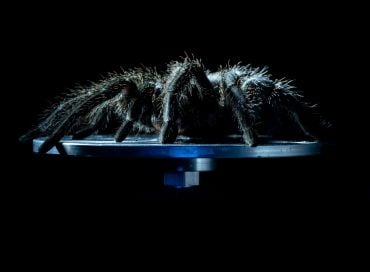 A Grammostola pulchra tarantula on a vibration plate in the Animal Vibration Lab. Credit: Thomas Miller.
Dr Beth Mortimer, who leads Oxford’s Animal Vibration Lab, said: ‘We are largely oblivious to the seismic signals that exist all around us, but which are so important for many animals. Our exhibit aims to bridge this perceptual gap as visitors immerse themselves in a new sensory perspective, challenging them to consider the limitations of their own sensory experiences in a rapidly changing world.’
Seismic Senses will feature a multisensory pod, to experience the seismic surroundings of elephants and spiders through touch, vision, and sound. Following a short introduction, they will encounter different scenarios – perhaps courting a potential mate, or a close shave with a predator- seeing, hearing, and feeling the seismic vibrations contained with the spiders’ and elephants’ world.
We are largely oblivious to the seismic signals that exist all around us, but which are so important for many animals. Our exhibit aims to bridge this perceptual gap as visitors immerse themselves in a new sensory perspective.
Dr Beth Mortimer, Animal Vibration Lab, Department of Biology
Dr Mortimer added: ‘Human activity is having a radical impact on the seismic environments of natural habitats, including through traffic, construction, and extreme weather events. This can interfere with how wild animals perceive vibrational information, and data collection by researchers.’
Ella McKelvey, Research Assistant at the Animal Vibration Lab, added: ‘Our exhibit includes the Seismic Scientist Training Academy - a digital game that challenges younger visitors to step into the steel-capped boots of a scientist working in the field. The players' mission? Use seismic signals to track migrating elephants and spot elusive wandering spiders. The twist? They'll have to sort real wildlife signals from seismic “noise”, such as vibrations from weather and passing traffic. These are the kinds of skills our researchers use every day.'
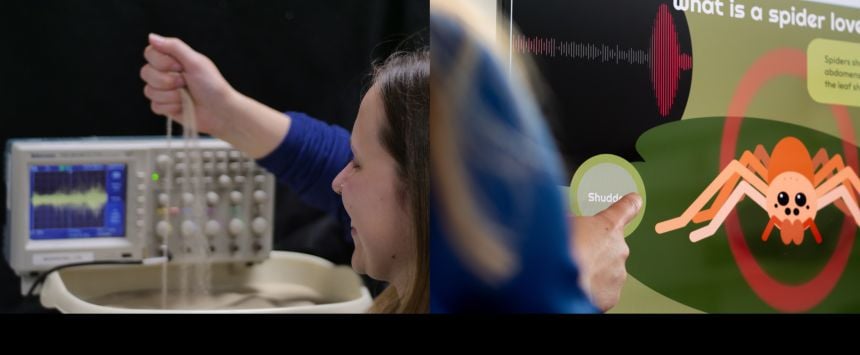 Left: A visitor to the Seismic Senses exhibit recording sand vibrations with real seismic sensors. Right: A visitor tests their signal identification skills in the Seismic Scientist Training Academy. Credit for both images: Dr Thomas Miller.
The Animal Vibration Lab in the Department of Biology works at the interface of biology, materials science, and engineering, using physical sciences techniques to understand how animals can use vibrations for biological information. One of their major projects aims to understand how spiders use web vibrations to detect prey, using computer models and laser tools to study how spiders move when they sense vibrations. Ultimately, this could inspire new robotic systems that use vibrations as an information source.
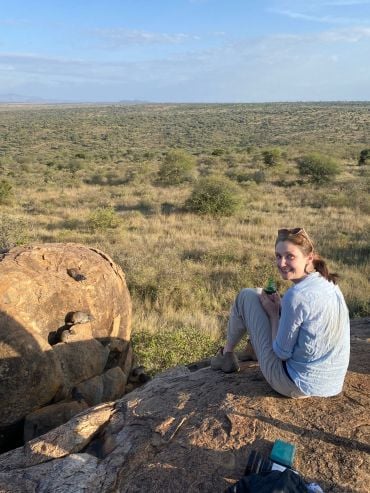 Dr Beth Mortimer. Credit: Animal Vibration Lab.
Dr Alice Morrell, Postdoctoral Research Associate for the Animal Vibration Lab, said: ‘In this exhibit, we’re inviting people to step into a world most of us never notice. Seismic Senses: from Spiders to Elephants brings our research to life through moving floors, immersive sound, and striking visuals. You’ll feel how spiders hunt and how elephants communicate, all through vibrations. It’s a hidden sense that is vital for these animals’ survival, and researching it could hold the key to breakthroughs in science, technology, and conservation."
More information about the Summer Science Exhibition can be found on the Royal Society website. The Exhibition will launch with a schools-only day on Tuesday 1 July, before the public are invited in at 6pm for an adult-only late-night opening. Public entry for all ages is from 10am Wednesday 2 July.
Learn more about how studying spiders' seismic senses could help inspire the next generation of robots:

 Oxford University spinout Dark Blue Therapeutics acquired to advance leukaemia treatment
 Expert Comment: Ethics-washing and Us-washing
 GSK, University of Oxford and Imperial College London launch centre to create computer models of lungs, liver, kidneys and cartilage
 World Happiness Report 2026 shows a complex global picture of social media and happiness
 Saïd Business School appoints first Poet Laureate
 Oxford University research showcased at the 2024 Royal Society Summer Science Exhibition
 Oxford University’s volcanic research showcased at Royal Society’s Summer Science Exhibition
 Oxford University research on show at the Oxford Science and Ideas Festival 2022