
Expert Comment: What US action in Venezuela could unleash — regionally and globally
Dr Annette Idler, Associate Professor in Global Security at the Blavatnik School of Government and Director of the Global Security Programme at Oxford’s Pembroke College, explores US actions in Venezuela and the potential impact on stability in the region and worldwide.
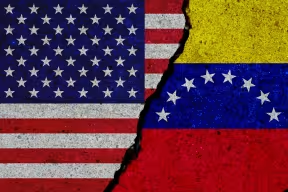

This came after months of a major US military build-up in the region, including ships such as USS Gerald R. Ford, the world's largest warship, numerous aircraft, and 15,000 troops.
Maduro, whose illegitimacy was accompanied by years of repression and human rights violations, now faces criminal charges related to drug trafficking in the US, while his former vice-president, Delcy Rodríguez, has assumed power in Caracas with the backing of the military and courts. Venezuela’s democratic opposition has not been given a role.
A capture is not a transition
The key point is this: removing an illegitimate ruler does not automatically produce stability. Coercion without legitimacy is one of the fastest ways to turn a crisis into prolonged insecurity.
The key point is this: removing an illegitimate ruler does not automatically produce stability. Coercion without legitimacy is one of the fastest ways to turn a crisis into prolonged insecurity.
Libya after 2011 is a warning case. Gaddafi was removed, but without a legitimate and inclusive political process, the country slid into prolonged violence, fragmentation and criminal activity.
US Secretary of State Marco Rubio has tried to narrow the framing, calling this a limited law-enforcement operation linked to drug trafficking. But US President Donald Trump has also spoken about ‘running’ Venezuela, and has been explicit that US companies should gain access to its oil — the largest proven reserves in the world, estimated at 303 billion barrels.
Those mixed messages create uncertainty about US intentions and the nature of any transition.
What might come next — and why it matters
Many Venezuelans want change. But durable change requires legitimacy, restraint and regional diplomacy, not domination dressed up as transition.
Many Venezuelans want change. But durable change requires legitimacy, restraint and regional diplomacy, not domination dressed up as transition.
When I started visiting Caracas and Venezuelan border states like Zulia, Apure, and Táchira more than a decade ago as part of my research, people told me they feared a US invasion.
Those fears weren’t abstract; they were tied to memories of past interventions and to daily insecurity in border regions. What’s striking is that those long-standing anxieties have now materialised, reinforcing a deep sense of vulnerability and mistrust that will outlast this moment.
This matters because perception shapes behaviour: fear can fuel mobilisation, resistance, and alignment with external protectors.
A full US occupation is unlikely, but the risks are real. Around 8 million people left Venezuela before this crisis, and renewed instability could push many more to flee. This puts huge pressure on health, housing, and education systems across the wider region.
There’s also a serious security risk. Armed militias, criminal networks and foreign armed groups such as the Colombian rebel group ELN already operate inside Venezuela and across its borders – and they do not answer to central authority. They often thrive in moments of chaos.
As my research shows, organised crime thrives when authority is fragmented and control is weak. Decades of evidence show that militarised drug policies do not reduce supply or demand — they fragment violence and expand illicit networks.
Colombia has already deployed 30,000 troops to the border, and tensions have risen sharply after President Trump threatened Colombia’s president, Gustavo Petro. The danger is spillover — violence, displacement, and instability spreading well beyond Venezuela.
Furthermore, despite claims this operation targets drug trafficking, organised crime — including drug traffickers with global operations — is likely benefiting from the current disorder. This is especially stark given President Trump has just pardoned Honduras’ former president who was imprisoned for cocaine trafficking.
As my research shows, organised crime thrives when authority is fragmented and control is weak. Decades of evidence show that militarised drug policies do not reduce supply or demand — they fragment violence and expand illicit networks.
The precedent problem
This also matters for geopolitics. The operation has fuelled tensions, with countries ranging from Brazil, Mexico and Spain to China, Iran and Russia condemning US actions, while others welcome Maduro’s removal. In fact, at the UN, the crisis has exposed deep divisions in the Security Council. Some governments argue the operation was justified, while others warn it violated Venezuela’s sovereignty and risks normalising unilateral force.
Beyond escalation, the deeper concern is precedent. President Trump is bypassing international law, treating sovereignty as optional and framing resource extraction as reimbursement. This echoes an old interventionist logic, where resource seizure is justified as compensation rather than governed by law.
Beyond escalation, the deeper concern is precedent. President Trump is bypassing international law, treating sovereignty as optional, and framing resource extraction as reimbursement. This echoes an old interventionist logic, where resource seizure is justified as compensation rather than governed by law.
That’s why global security is at stake here. The way power is exercised in Venezuela today will shape how it is used elsewhere tomorrow, from Latin America to other strategically sensitive regions such as Greenland — unless accountability, restraint, and a credible democratic path are finally prioritised.
For more information about this story or republishing this content, please contact [email protected]


