
Expert Comment: Why has the price of chocolate become so volatile?
Dr Tonya Lander, Stipendiary Lecturer at Christ Church and researcher at the Oxford Martin School Programme on the Future of Food, explains the diverse factors that impact the price of chocolate, and what measures could help improve the long-term resilience and stability of this global market that supports millions of livelihoods.



These price fluctuations don’t just affect consumers, of course, but a global industry valued at USD 100 billion annually and the livelihoods of the four to six million small-holder farmers who produce 90% of the world's cocoa beans.
This market volatility is driven by a complex mix of factors, from climate change to gold mining. Each of these may drive small changes, but together they have caused unprecedented instability. Understanding these factors may help us improve the long-term resilience of the industry, and support the farmers who provide its foundation.
El Niño and climate change
Chocolate price fluctuations don’t just affect consumers but a global industry valued at USD 100 billion annually and the livelihoods of the four to six million small-holder farmers who produce 90% of the world's cocoa beans.
El Niño is a weather phenomenon that occurs every 2-7 years in which warmer-than-average temperatures in the Pacific Ocean drive volatile weather patterns. In 2023-24 there was a ‘strong’ El Niño which, in West Africa, led to drier than usual weather, warmer temperatures and erratic rainfall. My research has highlighted how sensitive cocoa trees and their pollinators are to water availability and temperature. So, it is unsurprising that the El Niño weather was linked to poor cocoa harvests in both Côte d’Ivoire and Ghana (where 60-70% of global cocoa beans are produced), which contributed to cocoa price inflation. However, it’s worth noting that since 2000 there have been other El Niño years: 2002-3 and 2009-10 (‘moderate’), and 2015-16 (‘very strong’), which drove only very minor cocoa price fluctuations.
Although El Niño contributes to cocoa price volatility, climate change is also likely to have played a part. According to NASA, 2024 was the hottest year on record, and climate researchers generally predict increasing climate volatility and more extreme weather events in the future. Climate change has already affected crop yields around the world, and a recent study suggests that for every rise of one degree Celsius, global food production will drop by 120 calories per person per day, equal to approximately 4.4% of current consumption. Cocoa is as sensitive to climate variation as many staple crops, or more so, which means we can expect increasing variation in annual cocoa production as climate change progresses.
The challenges of tree crops
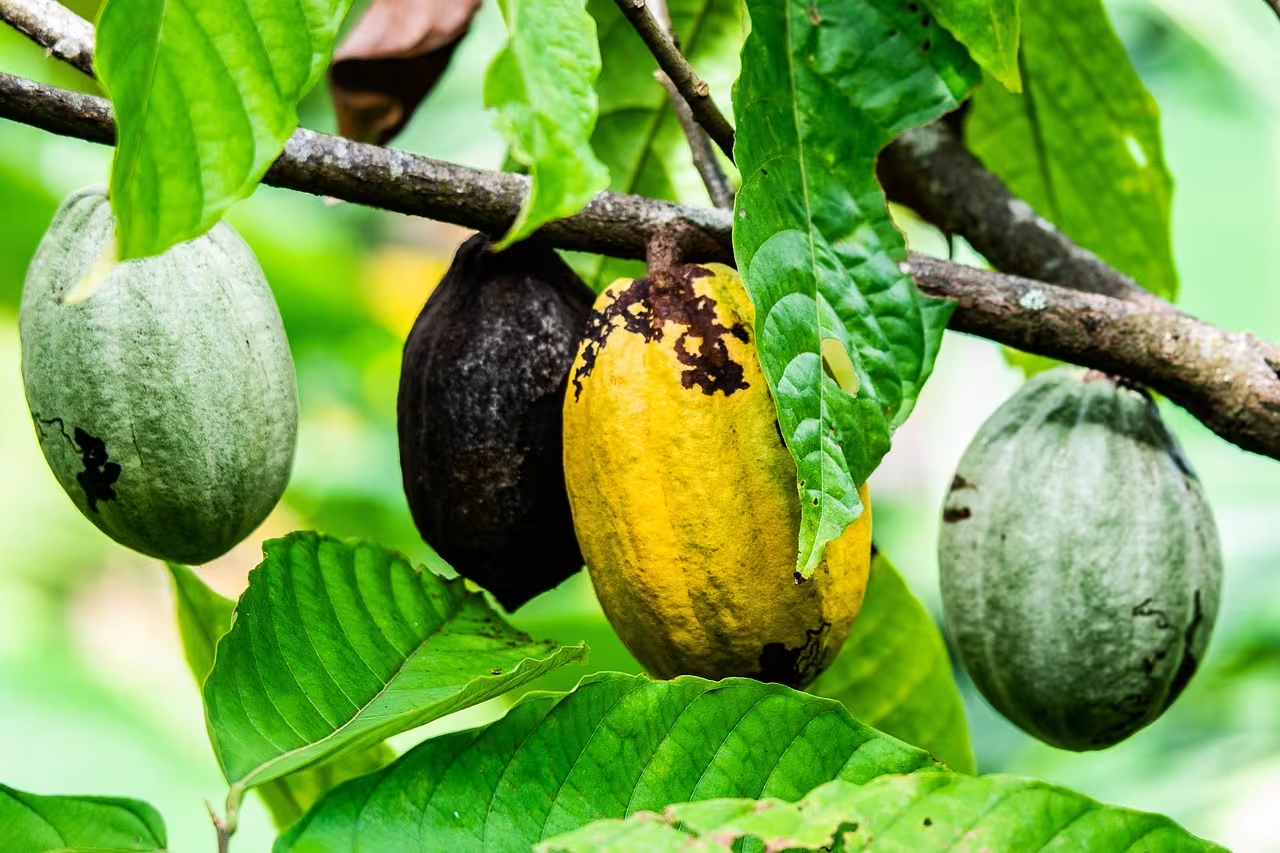
The socio-economic impacts for farmers of plantation replacement are not only economic, but relate to access to and ownership of new cocoa varieties, benefit distribution, financial and physical wellbeing, and potential loss of cultural heritage. Thus, farmers tend to be hesitant to replace existing trees, even if new varieties might have advantages under some climate change scenarios or be resistant to diseases such as cocoa swollen shoot virus (CSSV) which has been responsible for harvest losses of 15-50% in Ghana. Overall, this means that cocoa producers tend not to respond quickly either to a changing climate or to market signals to try to stabilize cocoa prices.
Trade tariffs and gold mining
US trade tariffs directly impacted both European chocolate exports to the US, and input costs for American producers. But they may also have indirectly driven up cocoa prices through their effects on the gold market.
Financial market forces also drive cocoa price volatility. For instance, the 2025 US trade tariffs almost certainly directly contributed to higher chocolate prices. These included a baseline tariff of 10% on all countries, a 20% tariff on chocolate imports from the European Union, and a 145% tariff on Chinese-manufactured packaging materials – which means they impacted both European chocolate exports to the US, and input costs for American producers. As the US consumes more chocolate than any other country, high prices for chocolate in the US, and rising costs for producers exporting to the US, drove up global chocolate prices.
Curiously, US trade tariffs may also have indirectly driven up cocoa prices through their effects on the gold market. Financial market instability following the announcement of US trade tariffs in early 2025 drove investors to buy precious metals, including gold. Illegal gold mining was already driving forest losses in Ghana, the sixth largest gold producer globally. With the volatility in cocoa prices and the strength of the gold market, many Ghanaian cocoa farmers sold their land to gold miners, reducing global cocoa production and causing major river contamination.
What the drivers of cocoa price volatility can teach us about sustainable cocoa production
In the short term, chocolate producers have responded to rising cocoa prices by passing the higher costs on to consumers and by producing products with less cocoa or with cocoa alternatives. This isn’t an ideal outcome for farmers who would like to continue growing cocoa.
Our research has found that sustainable agricultural practices that both protect pollinator populations and mitigate climate risks could help secure - and even improve - global cocoa yields.
Farmers may not be able to influence climate change or trade policy, but they can control plantation management, and there are some practical modifications which can help to make cocoa crops more climate resilient and potentially boost productivity.
Our research has highlighted that, for many cocoa plantations, insufficient pollination and higher temperatures are major constraints on production. This means that sustainable agricultural practices that both protect pollinator populations and mitigate climate risks could help secure - and even improve - global cocoa yields. These include maintaining leaf litter and other understory biomass to provide habitat for cocoa pollinators and preserve soil organic matter, as well as providing moderate shade in the plantation to reduce understory temperatures, and reducing agricultural chemical use to protect beneficial insects and soil and water quality. For example, agroforestry-like approaches that integrate non-cocoa crop trees and understory plants to provide shade, habitat and additional financial income have been found to stabilize farmer’s incomes, support biodiversity, combat disease spread and reduce climate change impacts.
Consumers can play their part by choosing organic, Fairtrade, or Rainforest Alliance certified chocolate. These certifications focus on farming in a way that protects biodiversity, giving farmers a fair price for their crop, protecting workers and avoiding child labour, and reducing the impacts of climate change.
By adopting biodiversity-centred, climate resilient farming techniques, the cocoa sector may be able to stabilize or even increase production, which could help safeguard farmers' livelihoods and contribute towards a more stable and sustainable cocoa market. So, hopefully chocolate will remain a luxury we can all enjoy for many years to come.
For more information about this story or republishing this content, please contact [email protected]


