
MSt in Medieval Studies
The MSt in Medieval Studies is a taught, interdisciplinary course combining language training, palaeography, codicology, and research methods. It includes option papers, seminars, and a dissertation based on independent research.
Full time
Important: Funding and costs information (below), including fee amounts and additional course costs, has been updated and relates to entry in 2027-28. All other information relates to entry in 2026-27.
Closed to applications for entry in 2026-27. Register to receive an email when applications open (for entry in 2027-28).
- Expected length
- 9 months
- Expected start date
- October 2026
- English language level
- Higher level required
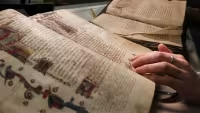
Detail of a medieval manuscript in the Bodleian Library (Image Credit: Tommaso Mari / Graduate Photography Competition)

About the course
The Faculty of History, English Faculty, Faculty of Medieval and Modern Languages, Faculty of Music, Faculty of Theology and Religion and the Faculty of Asian and Middle Eastern Studies all support the course, and it is administered by the Humanities Division.
This degree equips you to draw on a variety of disciplinary approaches to the study of the Middle Ages. It places emphasis on language training as well as on the development of skills in palaeography and codicology. It also offers the opportunity to undertake the acquisition of a medieval language not previously studied. You will follow a core course in research methods and choose from a range of taught option papers. You can also expect to spend at least a third of your time doing independent research with supervisors from at least two disciplines. You will also participate in a variety of workshops and exchanges.
Course structure
Teaching comprises:
- compulsory language classes
- palaeography/codicology classes in one of the participating departments;
- two option papers, one option in Michaelmas term and one option in Hilary term;
- seminars, including interdisciplinary seminars which underline the different but complementary approaches to medieval sources offered by different disciplines. In Trinity term, you will present work in progress on your dissertation at the interdisciplinary Medieval Church and Culture seminar;
- a research methods workshop designed to address issues encountered by researchers in medieval studies and intended to be responsive to and shaped by your concerns; and
- a dissertation of no more than 12,000 words on your own research topic.
In connection with the interdisciplinary seminar, a special week of additional research activities takes place each year. A particular expert in interdisciplinary medieval studies is invited to give a plenary lecture and seminar and to conduct a workshop for graduate students. This is an exciting opportunity for current students to discuss their work with a distinguished visiting scholar. Recent guest lecturers have included Caroline Walker-Bynum, Barbara Newman, Christopher Page, Jeffrey Hamburger, David D'Avray, Rita Copeland, William Miller, Miri Rubin, William Chester Jordan and Ardis Butterfield.
If you wish to apply for the DPhil you will be encouraged to develop your master’s dissertation and doctoral proposals in tandem during the first few months, so that you will be well placed to make a doctoral application.
Participating faculties' research is organised around historical periods, research centres, or in collaborative and individual research projects, and graduates are key participants in the wide range of seminars, workshops and conferences.
Further opportunities for exchange are provided by the interdisciplinary communities fostered within individual colleges, which also offer dedicated support for graduates by means of personal advisors. The Oxford Centre for Research in the Humanities (TORCH) offers a stimulating range of interdisciplinary activities, in particular the Oxford Medieval Studies Programme.
Core components
You will take classes, workshops, attend seminars and submit a dissertation.
Option modules
You will take language classes and two option modules.
Course details
Entry requirements
For entry in 2026-27