
MPhil in English Studies (Medieval Period)
The MPhil in English Studies (Medieval Period) is a two-year taught and research course offering advanced study in medieval English language, literature, and culture, with training in manuscript studies and two dissertations.
Full time
Important: Funding and costs information (below), including fee amounts and additional course costs, has been updated and relates to entry in 2027-28. All other information relates to entry in 2026-27.
Closed to applications for entry in 2026-27. Register to receive an email when applications open (for entry in 2027-28).
- Expected length
- 21 months
- Expected start date
- October 2026
- English language level
- Higher level required
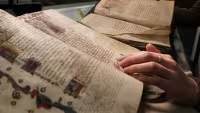
Image Credit: Tommaso Mari / Graduate Photography Competition

About the course
Oxford is now very rare in offering a two-year taught and research postgraduate course in medieval studies. The time and space this affords makes the Oxford MPhil the very best preparation for later specialist research in medieval literary or cultural history. It also stands alone as a thoroughly satisfying qualification indicating significant levels of critical, linguistic, and historical skill, expertise, and research competence, transferable to any future career.
The extra time involved in the two-year MPhil allows for internationally-recognised standards of expertise. The opportunities for interdisciplinary engagement are multiple, and the depth of research possible is unparalleled at master's level.
Course structure
In the first year, you will follow the MSt in English (650–1550). This already includes a broad grounding in medieval literature and culture, technical training in manuscripts, palaeography, and codicology (depending on courses taken), and the opportunity to pursue specific personal interests in coursework essays and in the MSt dissertation.
The first year consists of four main components spread over three academic terms, through which you have the opportunity to pursue interests within the MSt in English (650–1550), as well as across period boundaries.
In the first two terms, you will take a core course (A) and a course in book history and theories of text (B), both tailored to your MSt. There is no formal assessment for the A Course, but written work and/or oral presentations may be required.
You will also choose two courses from a wide range of options (C). One is taken in the first term and one in the second term. The courses are taught in weekly, small group seminars. You are not constrained to follow option courses in the designated period and, indeed, option courses often traverse the boundaries of the broad periods and subject groups.
Under the guidance of a specialist supervisor you will also research and write a dissertation, which is submitted in the final term. You will be assigned to a member of academic staff who will act as your supervisor. Students will have the opportunity to present their dissertation ideas at a one-day conference that they organise, usually at the start of Trinity term
In the second year, students have the opportunity both to broaden and deepen their knowledge, adding further options and taking advantage if they wish of courses offered by specialists in other faculties. Students finally submit a second, longer dissertation, which may form the basis of doctoral research, or a substantial publication.
You will have the opportunity to hear lectures and papers by leading writers, critics, and theorists from inside and outside the University. You are encouraged to participate in the many research seminars and reading groups that run throughout term time, many of which are coordinated by graduates themselves. There is an active and lively graduate organisation funded by the faculty, English Graduates at Oxford (EGO), that organises study skills, training and career development seminars, as well as social events and conferences.
Core components
You will take two core courses, and submit two dissertations.
Option modules
In your first year, you will choose two courses from a range of options. In your second year, you will have the opportunity to take further options.
Course details
Entry requirements
For entry in 2026-27