
DPhil in Chemistry
The DPhil in Chemistry is a research-based course at Oxford focused on original projects across areas like catalysis, materials, energy, biology interface, and theoretical chemistry. It develops advanced research and transferable skills.
Full time
Important: Funding and costs information (below), including fee amounts and additional course costs, has been updated and relates to entry in 2027-28. All other information relates to entry in 2026-27.
Closed to applications for entry in 2026-27. Register to receive an email when applications open (for entry in 2027-28).
- Expected length
- 3-4 years
- Expected start date
- October 2026
- English language level
- Standard level required

About the course
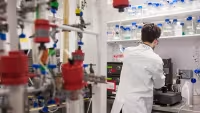
The main aspect of the course is an original research project, which develops research skills, knowledge and expertise in an area of cutting-edge chemistry. You will work with one or more academic supervisors, on a project that falls within the department's research themes.
Many students work on projects that cut across the traditional boundaries of chemistry, and some work in interdisciplinary fields that exploit the Department of Chemistry's strong connections with other departments of the University. Students are supervised by some of the country’s most gifted research chemists, many of whom have world-class reputations.
You will work in an environment which encourages and inspires you to acquire and develop a wide range of communication, study, and research skills.
A typical week would primarily be spent carrying out your research, along with attending research group meetings, preparing reports, and keeping up-to-date with the scientific literature. You will also have access to a range of training opportunities, including specialist training within the department on key research techniques. Alongside your research project, you will be expected to develop your transferable skills, and many courses and opportunities for this are provided by the Mathematical, Physical and Life Sciences division and the wider University.
The Department of Chemistry has a strong and vibrant research community, of which you will become part, and you will be encouraged to attend a range of events including seminar series, lectures from distinguished visiting researchers, and the annual Graduate Symposium.
Research areas
You will have the opportunity to undertake research within the specialised themes of this course.
Course details
Entry requirements
For entry in 2026-27