
Expert Comment: How can we effectively regulate international trade in wild species?
Dr Dan Challender, a conservation scientist at the Department of Biology and Oxford Martin School, argues that CITES CoP20 demonstrates we need to reform how decisions on international trade controls for wild species are made if they are to be protected from overexploitation.
 Dr Dan Challender. Photo credit: David Fisher.
Recently, the world’s governments convened in Samarkand, Uzbekistan for the 20th meeting of the Conference of the Parties (CoP20) to CITES, the Convention on International Trade in Endangered Species of Wild Fauna and Flora. CITES is the primary multilateral environmental agreement through which international trade in nearly 41,000 species is regulated. CITES was established in 1975 and is considered by some to be one of the most successful international environmental agreements. Participating countries must enact legislation to implement the Convention and the harvest and international trade in species covered by CITES is regulated using a system of permits and certificates.
We know from the last 50 years of regulating international wildlife trade that CITES trade controls may be positive or negative for species and change over time. Decisions to apply these controls really ought to consider outcomes for both wildlife and people in much more realistic terms.
At CoP20, Parties to the Convention took decisions to apply new, or revising existing, international trade controls for species ranging from manta and devil rays to seed finches and Indian bdellium plants. Thirty-eight of 51 proposals were adopted, meaning that for some species international trade will now be closely regulated and for others, commercial international trade in specimens taken from the wild will be prohibited. Seventy-eight species were newly added to CITES. These measures are designed to protect species, so surely this is a cause for celebration. Well, no, not necessarily.
Myself and colleagues at Oxford recently evaluated the effectiveness of CITES by asking the question, is the Convention preventing the overexploitation of species for international trade – the very problem it was designed to address? Worryingly, our research indicates that CITES is not as effective as it could be for several reasons:
- Around one-third of participating countries, mainly in the Global South, have not set up legislation to adequately implement and enforce CITES;
- Relevant actors (e.g., hunters and exporters) may not be aware of applicable laws or are not motivated to comply with them;
- Law enforcement agencies are often not adequately resourced to deter illegal harvest and trade of species;
- Regulating or prohibiting commercial international trade in species does not necessarily lead to compliance by actors.
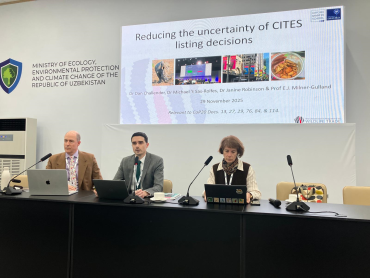 Dr Dan Challender (centre) presenting at CoP20.
Evaluating the likely impact of CITES trade controls on wildlife and people before these measures are established is therefore essential, but this rarely receives the attention it deserves both prior to, and during, CoP meetings. For many proposals to apply these trade controls, potential risks are simply not considered. For others, Parties make decisions despite the identification of major risks and without considering mitigation measures.
For instance, at CoP20 the Parties agreed to introduce a ban on commercial international trade in wild great-billed seed-finches (Sporophila maximiliani). This was despite captive breeding organisations highlighting that this may increase pressure on wild populations and hasten their extinction. This is plausible because in the time it takes to register 37,000 captive breeding organisations under CITES (which is necessary when an international trade ban is in place), the most likely source of birds for the market is those caught from the wild.
Ideally, decisions on international trade controls for species would be based on an analysis of the human-environment systems in which the harvest, use, and trade of species occur and how these systems function.
CITES has been successful and played a positive role in the conservation of certain species by verifiably helping to prevent overexploitation for international trade. A good example is the vicuña (Vicugna vicugna), a small camelid in South America, whose status has improved over time. This was possible because CITES trade controls were situated within broader institutional arrangements that considered not only the species’ life history but also socio-cultural factors, land tenure, resource access, benefits to local communities and indigenous peoples, and economic factors, among others.
In our study, we argue that the CITES Parties should reform how they make decisions on establishing international trade controls for species. Ideally, this would be based on an analysis of the human-environment systems in which the harvest, use and trade of species occur and how these systems function. The insights generated could be used to (re-)form institutional arrangements along supply chains. This would involve assessing formal institutions such as laws and property rights, including how CITES trade controls fit in, and informal institutions such as social norms and codes of conduct.
 Pangolins are threatened by overexploitation. Credit: Getty Images.
It may not be possible to apply this approach to all species that may benefit from international trade controls under CITES, particularly those that are globally distributed (e.g., some sharks). At the very least, Parties proposing trade controls should explicitly identify potential risks to species and outline how they will be monitored and mitigated.
Since CoP20 concluded, many organisations have been celebrating increased ‘protections’ for wildlife, including major conservation NGOs. Whether decisions taken in Samarkand will help or hinder species conservation will depend on the extent to which trade controls are implemented, how trade dynamics may change over time, and whether there are any adverse impacts. To reduce the uncertainty of these decisions in the future, CITES Parties ought to evaluate potential impacts of international trade controls in much more realistic terms, including appropriate mitigation measures.
For more information about this story or republishing this content, please contact [email protected]

 International trial finds rapid diagnostic testing alone does not reduce antibiotic prescribing for respiratory infections
 Oxford historian named 2026 Holberg Prize Laureate
 Researchers reveal a new class of molten planet
 New research reveals why some oesophageal cancers are so hard to treat
 Oxford and Serum Institute of India sign IP license agreement to advance NipahB vaccine candidate
 Nearly 8,000 animal species at risk as extreme heat and land-use change collide
 Expert Comment: National Emergency Briefing - Nature is not a ‘nice-to-have’, it is critical national infrastructure
 Expert Comment: Reflections on COP30 in Belém