

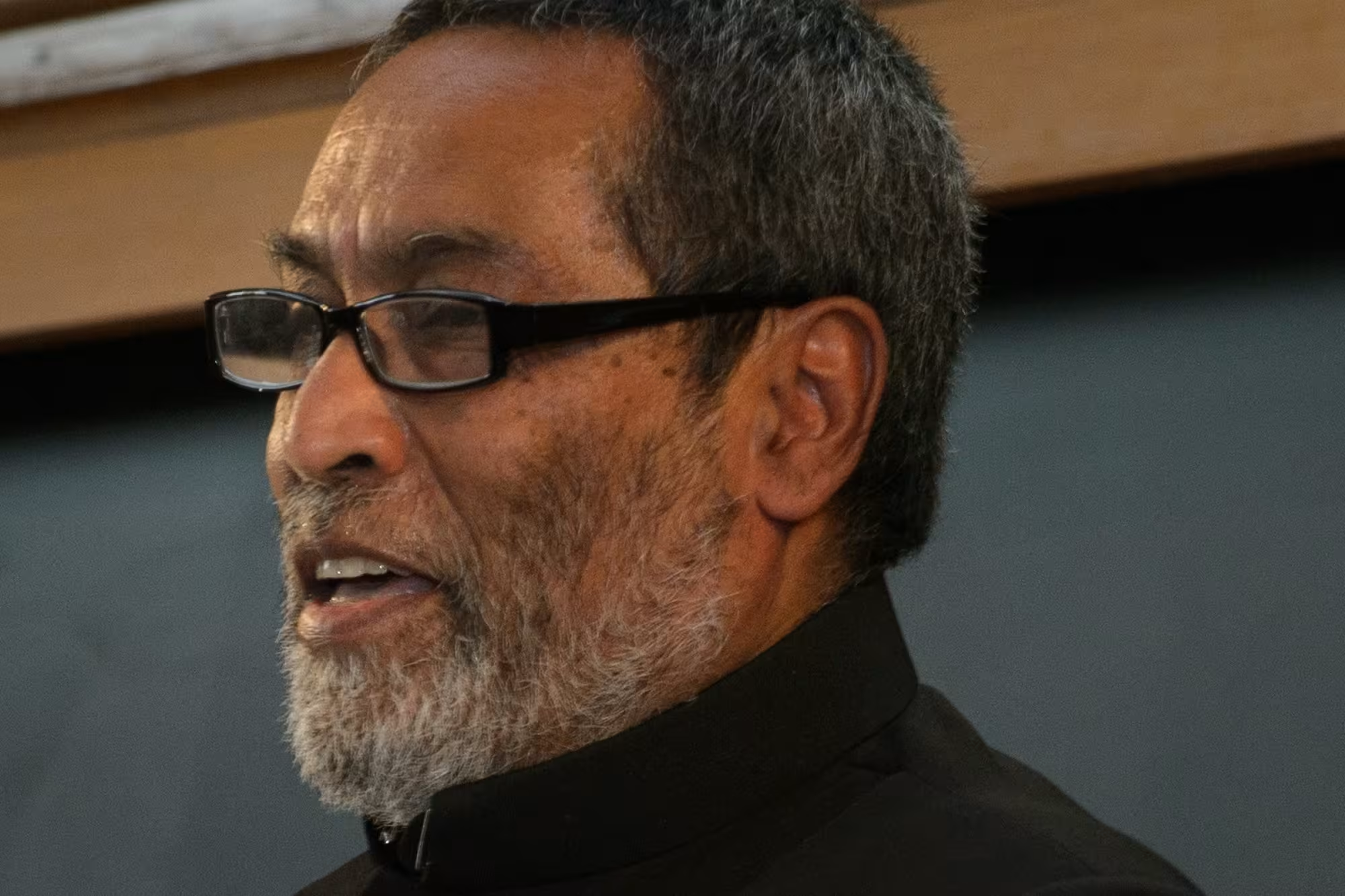
Professor Subir Sarkar
Professor Emeritus in Physics, Department of Physics
Professor Sarkar is a theoretical physicist who also works on experiments. His research is focussed at the interface between fundamental physics and cosmology. In 2018 the International Union of Pure & Applied Physics awarded him the Homi Bhabha medal & prize for "distinguished contributions in the field of high energy cosmic ray physics and astro-particle physics over an extended academic career".
About
Professor Subir Sarkar was born and educated in India. He obtained his PhD (1982) at the Tata Institute of Fundamental Research, Bombay, and held postdoctoral positions at Oxford Astrophysics, SISSA Trieste, CERN Geneva & RAL Chilton. Since 1990, Professor Sarkar has been at the Rudolf Peierls Centre for Theoretical Physics, Oxford, where he was Head of the Particle Theory Group (2011-19). He is now Professor Emeritus in Physics and Emeritus Fellow of Linacre College, Oxford.
Professor Sarkar's research interests are at the interface of fundamental physics with cosmology and astrophysics, covering topics such as big bang nucleosynthesis, dark matter, dark energy, inflation, etc. He also studies high energy cosmic rays, gamma-rays and neutrinos, and is a member of the IceCube Neutrino Observatory and Cherenkov Telescope Array collaborations (previously he worked on the Pierre Auger Observatory for cosmic rays and the BEBC Beam Dump experiment at CERN). Professor Sarkar participates in laboratory experiments using high powered lasers to investigate astrophysical processes, and in the Legacy Survey of Space and Time on the Vera Rubin Observatory.
He has strengthened academic links between Oxford and India, being a founder member of the India Oxford Initiative, as well as coordinator of the Oxford-India Network in Theoretical Physical Sciences and Senior Member of the Oxford India Society.
Expertise
- Astrophysics
- Black holes
- Cosmology
- Dark matter
- Particle physics
- Physics
- Astronomy
- Public understanding of science
Selected publications
Find a full list of downloadable publications here
- Colloquium: The cosmic dipole anomaly (2025)
- Heart of Darkness, Inference: International Review of Science 6 (2022)
- A test of the cosmological principle with quasars (2021)
- Do supernovae indicate an accelerating universe? (2021)
- Evidence for high-energy extraterrestrial neutrinos at the IceCube Detector (2013)
- Observation of the suppression of the flux of cosmic rays above 4 ×10¹⁹ eV (2008)
- Is the evidence for dark energy secure? (2007)
- Possible astrophysical probes of quantum gravity (2002)
- Tests of quantum gravity from observations of γ-ray bursts (1998)
- Big bang nucleosynthesis and physics beyond the standard model (1996)
Media experience
Professor Subir Sarkar has extensive media experience including working with news organisations such as BBC News and The Telegraph. During 1988-89, he also worked in science education and outreach for the NGO Eklavya in Bhopal.
Recent media work
- Does dark energy really exist? Our work identifies cracks in the foundations of today’s cosmological model (The Conversation, 2026)
- The universe may be lopsided – new research (The Conversation, 2025)
- First ever view of the Milky Way seen through the lens of neutrino particles (The Conversation, 2023)
- Milky Way: Icy observatory reveals 'ghost particles' (BBC News, 2023)
- Cosmologists parry attacks on the vaunted cosmological principle (Quanta Magazine, 2021)
- Dark Matter May Be Missing from This Newfound Galaxy, Astronomers Say (Scientific American, 2021)
- Is the Universe different in different directions? (The Wire Science, 2021)
- Doubts about dark energy (Spektrum, 2020)
- New form of astronomy: Physicists capture neutrino from distant galaxy (Videnskab.dk, 2018)
- Telescope buried in Antarctic ice detects elusive neutrinos (The Telegraph, 2013)
- Faster than light particles found, claim scientists (The Guardian, 2011)
Languages
English, Hindi, Bengali