
MSc in Refugee and Forced Migration Studies
The MSc in Refugee and Forced Migration Studies places forced migration in an academic framework, preparing you for doctoral study or for work relevant to human rights, refugees, and migration.
Closed to applications for entry in 2026-27. Register to receive an email when applications open (for entry in 2027-28).
- Expected length:
-
- Full time: 9 months
- Expected start date:
-
- Full time:
- English language level:
-
- Higher level required
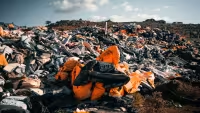
A pile of discarded lifejackets on a Greek island (Getty Images / Casper te Riele)

About the course
The course provides an intellectually demanding, interdisciplinary route to understanding forced migration in contexts of conflict, repression, natural disasters, environmental change and development.
You will gain an understanding of the complex and varied nature of forced migration and refugee populations, of their centrality to global, regional and national processes of political, social and economic change, and of the needs and aspirations of forcibly displaced people themselves. You will also develop a broad understanding of academic research related to forced migration and refugees, engage in critical thinking and acquire sound evaluative tools.
You will gain the ability to plan, organise and carry out research into aspects of forced migration and refugee studies, as well as the skills necessary to convey theoretical knowledge of forced migration to a variety of different audiences.
Course structure
In the first and second terms you will follow core courses that introduce the subject of forced migration from a range of disciplinary perspectives, including anthropological, political and legal perspectives. There is also a two-term course dedicated to research methods relevant to the study of forced migration.
In the second term you will choose two options courses from a list which changes from year to year.
In the third term, you will write a thesis.
Teaching takes place in small classes, usually from 5 to 25 students, including regular one-to-one supervisions. This emphasis on small group teaching helps encourage active participation, enabling students to learn from each other as well as from department’s teaching staff, who are all leading experts in the field of forced migration, drawn from a range of disciplines typically including anthropology, geography, international law, history and politics, international relations, sociology and development studies.
Teaching styles vary, including lectures, workshops, individual and group tutorials, seminars and student presentations. You will be expected to prepare for class by reading a selection of recommended books, book chapters and articles and by preparing formative essays and presentations. There will be around two hours of formal teaching each weekday during term time, with informal group work and self-directed study expected to take up an additional six hours each day.
As a student on the course you will have access to a wide range of public seminars organised by the department, including the RSC Public Seminar Series. Beyond the immediate degree, Oxford offers a great variety of events, including seminars and lectures by distinguished academics and policy-makers in related fields. Other RSC resources include Forced Migration Review and the RSC Working Paper Series, to which students who are awarded a distinction for their thesis may be invited to contribute.
Core components
You will take core courses, a research methods course and submit a thesis.
Option modules
You will choose two option modules.
Course details
Entry requirements
For entry in 2026-27