
MPhil in Buddhist Studies
Offers training in a primary Buddhist canonical language and in-depth study of Buddhist history, philosophy, literature and practice, with options for further language or thematic study and the chance to deepen your research with a thesis.
Full time
- Upcoming application deadline for 2027-28 entry:
- 12:00 midday UK time on Tuesday 5 January 2027
- Expected length
- 21 months
- Expected start date
- October 2027
- English language level
- Higher level required
Application deadlines
Final application deadline for entry in 2027-28
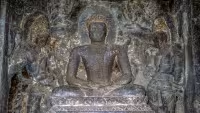
A stone sculpture of Buddha in meditation posture inside the Ajanta Caves. Credit: Getty Images / Takayuki Ueda.

About the course
The MPhil in Buddhist Studies is designed for students who wish to study Buddhism through a strong foundation in primary sources and their original languages. The first year establishes this basis through intensive language training and a broad introduction to Buddhism. The second year continues advanced language study and moves to the consideration of the different methods used for the study of Buddhism, while allowing students to deepen their research into the historical and lived manifestations of the tradition.
Buddhism is an exceptionally rich religious tradition with a long history and a vast geographic spread. The programme offers a firm grounding in early Buddhist teachings and traditions (primarily from the Pāli canon and its parallels in Prakrits, Sanskrit and Chinese translations). It then progresses to Mainstream and Mahāyāna schools before extending into major non-Indic traditions: Southeast Asian (Pali commentarial and vernacular traditions), East Asian (utilising the extensive Chinese canon), and Tibetan-Himalayan Buddhism. Finally, the course examines Buddhism on a global scale.
Students are expected to ground themselves in classical texts and their doctrinal content as they explore the diverse manifestations that have evolved over more than two millennia, including living practice. Through advanced coursework and the preparation of a final thesis, students will become familiar with broader scholarship in the field while developing specialist skills for original research. They will also explore the global history of Buddhism and its impact on the development of modern Buddhist studies.
Students with specific research interests or those requiring additional languages (including vernaculars) should consult with the course director. Please note that while examinations are based on the core curriculum listed below, students are welcome to audit a wider diversity of relevant classes and lectures with the permission of the respective tutor or lecturer.
This degree can be a standalone qualification or preparation for doctoral research.
Course structure
You will be requested to select a primary Buddhist canonical language. The first year focuses on intensive training in all aspects of your chosen language, without presuming previous knowledge of it, and takes advantage of the linguistic expertise available at Oxford. Sanskrit is a difficult language to learn and evidence of prior experience of language learning is preferred.
Study of the chosen language is complemented by training in various aspects relevant to the study of Buddhism, including historical, literary, philosophical and ethnographic. Teaching happens through lectures, seminars and tutorials, utilising the small group practice characteristic of Oxford. Your training is also supported by a rich provision of visiting lectures, research seminars and workshops.
This solid base of training is built on in the second year with the in-depth study of important Buddhist texts in the original language in which you are specialising and an analytical approach to Buddhist studies as an academic discipline.
You are also required to choose one optional paper in the second year.
Core components
You will receive language training, take two core courses, and write a dissertation.
Option modules
You will choose one option course.
Course details
Entry requirements
For entry in 2027-28