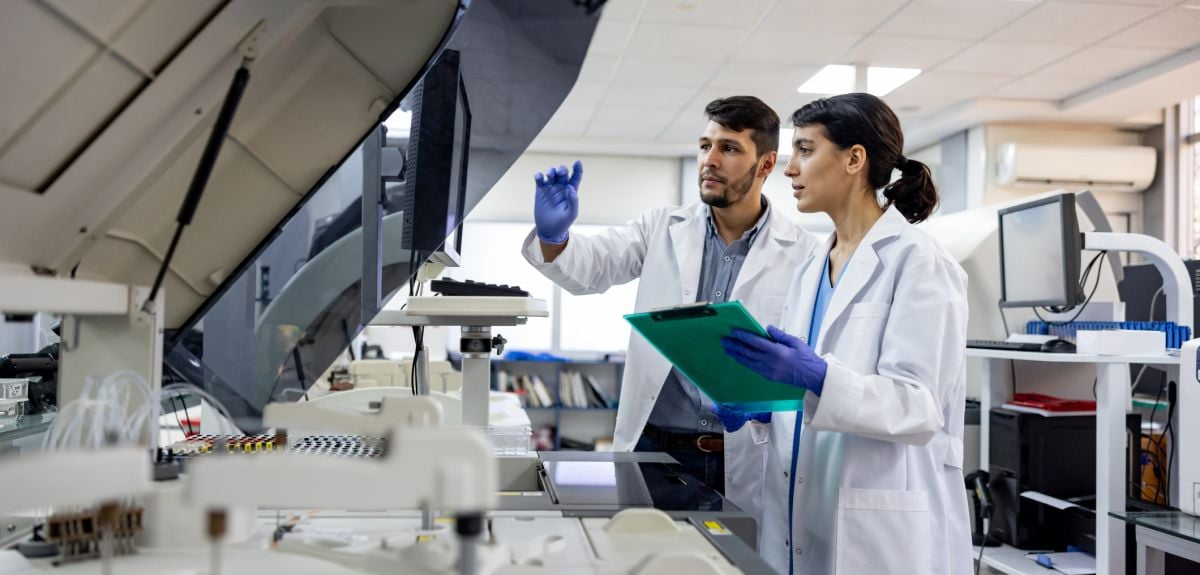
Existing hospital analysers offer a low-cost method to screen for fake vaccines
An international team of researchers led by the University of Oxford and Oxford University Hospitals NHS Foundation Trust have demonstrated that hospital analysers can be used to identify fake liquid medical products.
The World Health Organization (WHO) estimates that 10.5% of medicines worldwide in low- and middle-income countries are substandard or are falsified (i.e. fake). These medicines and vaccines fail to prevent and treat the diseases for which they are intended and risk additional adverse health consequences if the ingredients used in the falsified products are harmful, resulting in a threat to global health.
By repurposing a clinical chemistry analyser to detect and measure different salts and protein in liquid medical products, we were able to successfully differentiate genuine and falsified samples. This novel approach can be used globally due to the worldwide availability of biochemical analysers in hospitals and other clinical settings, including in low- and middle-income countries, where many cases of falsified medicines have been reported.
Dr Bevin Gangadharan, Department of Biochemistry and Kavli Institute for Nanoscience Discovery
The Vaccine Identify Evaluation (VIE) Collaboration is developing novel tests for detecting falsified vaccines in supply chains.
Now, for the first time, this international consortium has demonstrated that widely available and routine hospital analysers provide a low-cost means to accurately differentiate genuine liquid medical products from falsified surrogate samples.
This technique is not intended to replace reference assays, but to screen samples that need further investigation in specialised laboratories.
The consortium includes representatives from the University of Oxford’s Nuffield Department of Medicine, Department of Biochemistry, Kavli Institute for Nanoscience Discovery, Pandemic Sciences Institute and Department of Chemistry; the Oxford University Hospitals NHS Foundation Trust; STFC, part of UK Research and Innovation (UKRI); the University of East London; the World Health Organization (WHO), Geneva; the Serum Institute of India; and Agilent Technologies.
Study co-lead, Dr Bevin Gangadharan, Department of Biochemistry and Kavli Institute for Nanoscience Discovery, University of Oxford, said: 'By repurposing a clinical chemistry analyser to detect and measure different salts and protein in liquid medical products, we were able to successfully differentiate genuine and falsified samples. This novel approach can be used globally due to the worldwide availability of biochemical analysers in hospitals and other clinical settings, including in low- and middle-income countries, where many cases of falsified medicines have been reported.'
VIE project lead, Professor Paul Newton of the Centre for Tropical Medicine and Global Health, University of Oxford, said: 'There is a great need for accessible and inexpensive techniques for screening for falsified vaccines and liquid medicines-this novel approach of repurposing existing widely available hospital analysers holds promise for detecting these before they reach patients so that timely and appropriate action can be taken.'
Study co-lead, Professor Tim James, John Radcliffe Hospital, Oxford University Hospitals NHS Foundation Trust, said: 'One of the benefits of the approach taken to screen vaccines and insulin suspected of being falsified is the ability to select from a range of simple, highly reproducible, routine methods from the instruments repertoire to meet any given testing scenario thereby providing flexibility.'
The study ‘Biochemical profiling provides a low-cost and globally accessible method to detect falsified vaccines and insulin’, has been published in Scientific Reports.
For more information about this story or republishing this content, please contact [email protected]

 Kennedy Institute of Rheumatology secures five-year major funding from the Kennedy Trust for Rheumatology Research
 Oxford’s women triumph in historic 80th boat race
 Spectacular fossil treasure trove pushes back origins of complex animals
 Oxford scientists uncover how the brain resolves emotional ambiguity
 Expert Comment: In Claude We Trust? Evaluating the New Constitution
 Rapid, low-cost tests can help prevent child deaths from contaminated medicinal syrups
 New screening method finds novel approaches to combat antimicrobial resistant bacteria
 New method developed to detect fake vaccines in supply chains