

Professor Ilina Singh
Professor of Neuroscience and Society, Department of Psychiatry
About
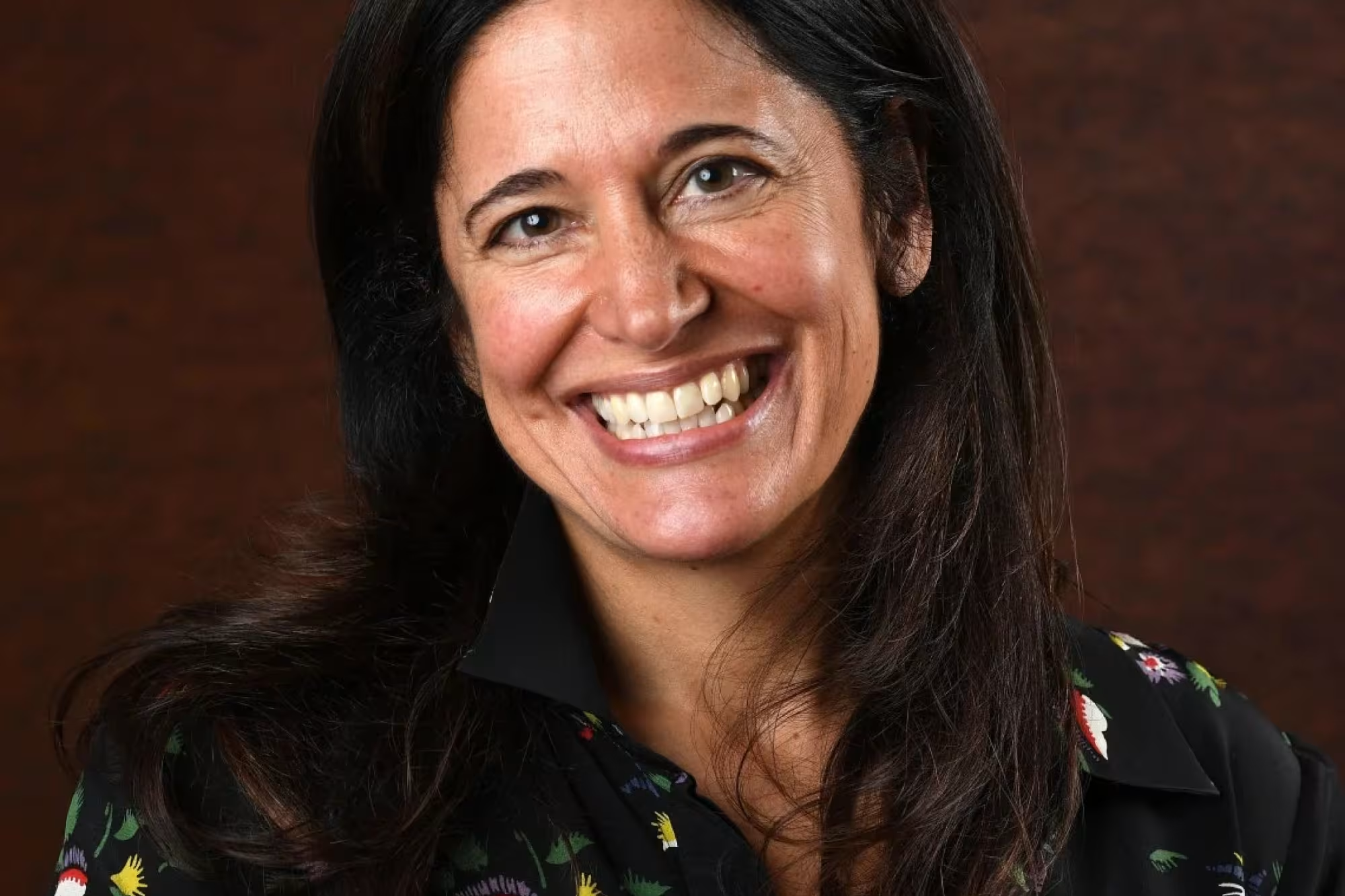
Professor Ilina Singh is Professor of Neuroscience and Society in the Department of Psychiatry at the University of Oxford.
Professor Singh holds a doctorate in human development and psychology from Harvard University, and over the past decade has added to these foundations through extensive work in bioethics, methods innovation and sociology, bringing this interdisciplinary perspective to current research through an approach known as empirical ethics. At present, her team's major research projects encompass: nature-based interventions for flourishing and wellbeing; AI and digital mental health ethics; and global mental health ethics.
Much of her work reflects a longstanding commitment to bringing the first-person experiences of children and young people into ethical evaluation, clinical decision-making and policy-making. Professor Singh's team has pioneered participatory methods for co-design and co-production with young people, qualitative and quantitative methods, mobile technologies and digital games.
Current Projects
Professor Singh is a co-principal investigator for the Oxford Wellcome Platform for Transformative Inclusive Bioethics (ANTITHESES), where she leads the Design Bioethics Lab on the neuroethics of new forms of collective and collaborative decision-making, including swarm and hive minds, brain-computer interfaces, and novel AI technologies. Her team also contributes to work on global genomic ethics through their global mental health ethics programme. They are funded for various projects through a partnership with the Stanley Centre, Broad Institute of Harvard and MIT; British Academy; Global Challenges Research Fund, Africa-Oxford Initiative, and others.
She leads the NIHR Biomedical Research Centre Flourishing and Wellbeing Theme. This is a major cross-University initiative to build the evidence-base for green social prescribing in mental health and aiming to identify key mechanisms driving positive connections between mental health and nature-based interventions and experiences in young people and in older adults. Work is founded on the principle that 'flourishing' connotes good for the individual and good for the planet. Further work on nature-based programmes for mental health and wellbeing in UK schools is supported by a NERC Agile Initiative grant in partnership with the UK Department for Education: AGILE: Is Nature a Policy Solution to Mental Health in Schools?
Professor Singh is also a co-investigator on a Wellcome Discovery Award (PI Prof Argyris Stringaris, UCL) where her role is to investigate the ethics of 'surprises' (or expectancy violations) in therapies targeting severe social anxiety.
Past projects include: A Senior Investigator Award from the Wellcome Trust for a project entitled: Becoming Good: Early Intervention and Moral Development in Child Psychiatry, 2015-2020. This project follows on from a Wellcome Trust University Award for VOICES: Voices on Identity, Childhood, Ethics & Stimulants: Children join the debate. Projects have added significantly to innovative methods in working with young people. A Wellcome Trust Enrichment Award enabled the creation of a bioethics game on mental health digital phenotyping. Professor Singh also led the UK Ethics Accelerator for Pandemic Emergencies, funded by the UKRI Covid-19 Rapid Response Call, involving five UK institutions and nine leading UK bioethicists as Co-Directors, along with six postdoctoral fellows and the Nuffield Council of Bioethics as a key partner – a project funded by the Duke of Westminster Foundation for a trial of a peer-support intervention for mental health and wellbeing, aimed at the challenges faced by adolescents during the epidemic crisis.
Expertise
- Working with children with certain mental health conditions – particular experience working with children who have ADHD, Autism and/or Social Anxiety
- Children’s mental health and nature-based solutions – how school-based programmes involving nature and the outdoors can support mental health and wellbeing in children and young people, working closely with the Department of Education
- Ethical use of AI and digital tools in mental health – exploring ethical risks and benefits of using artificial intelligence, chatbots and other digital technologies to support mental health, especially for children and in lower-income countries
- Young people’s voices in mental health research and policy – developing innovative ways to involve children and teenagers in designing mental health research and services, ensuring their voices shape real-world decisions
- Ethics of global genetic and neuroscience research – advising on the ethical challenges of using genetic data from children, particularly in African countries, and how to ensure such research is fair, respectful and inclusive
- Mental health inequalities and social justice – how wider social and policy factors, such as poverty, inequality or education, affect children's mental health, and what can be done to reduce these disparities
- Ethics in emergency health responses – led a national ethics programme that provided rapid advice to government and health leaders during the COVID-19 pandemic. Professor Sing can speak about how ethics should guide responses to health emergencies
- The role of surprise and moral development in therapy – how unexpected experiences in therapy can help young people grow emotionally and ethically, and how this might improve mental health treatments
Selected publications
- Nature for student's life: The impact of outdoor greenness on mental wellbeing and chronic absenteeism (OSF, 2025)
- The Double-Edged Sword of Anthropomorphism in LLMs (Proceedings, 2025)
- ‘A commitment to Equality, Diversity and Inclusion’: a conceptual framework for equality of opportunity in Patient and Public Involvement in research (Research Ethics, 2024)
- Effect of nature on the mental health and well-being of children and adolescents: meta-review (The British Journal of Psychiatry, 2024)
- Tracing Tomorrow: young people’s preferences and values related to use of personal sensing to predict mental health, using a digital game methodology (BMJ Mental Health, 2024)
- Online peer-led intervention to improve adolescent wellbeing during the COVID-19 pandemic: a randomised controlled trial (Journal of Child Psychology and Psychiatry, and Allied Disciplines, 2024)
- Merging Minds: The Conceptual and Ethical Impacts of Emerging Technologies for Collective Minds (Neuroethics, 2023)
Media experience
Professor Ilina Singh has experience being interviewed by publications and also being on Science Media Centre panels.