
MSc in Mathematical and Theoretical Physics
Comprehensive training in mathematical and theoretical physics, preparing students for doctoral-level work in the field.
Full time
- Upcoming application deadline for 2027-28 entry:
- 12:00 midday UK time on Wednesday 27 January 2027
- Expected length
- 9 months
- Expected start date
- October 2027
- English language level
- Higher level required
Application deadlines
Final application deadline for entry in 2027-28
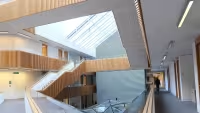
Inside the Andrew Wiles Building, Mathematical Institute (University of Oxford Images / Public Affairs Directorate)

About the course
Taught across the University’s Mathematical Institute and Department of Physics, the course concentrates on the main areas of modern mathematical and theoretical physics:
- elementary-particle theory, quantum field theory, theories of gravity and string theory
- condensed matter theory (both quantum and soft matter)
- theoretical astrophysics, such as planetary and galactic dynamics, and cosmology
- plasma physics and the physics of continuous media (including fluid dynamics and related areas often associated with courses in applied mathematics in the UK system)
- mathematical structures underlying physical theory
If you are a physics student with a strong interest in theoretical physics or a mathematics student keen to apply high-level mathematics to physical systems and their underpinning mathematics, both pure and applied, this is a course for you.
The course offers considerable flexibility and choice; you will be able to choose a path reflecting your intellectual tastes or career choices. This arrangement caters to you if you prefer a broad theoretical education across subject areas or if you have already firmly set your sights on one of the subject areas, although you are encouraged to explore across sub-field boundaries.
The MSc offers an opportunity for independent study and research in the form of an optional dissertation.
Course structure
There are no compulsory courses as part of this degree. However, several courses covering fundamental principles are held in Michaelmas term that courses in Hilary or Trinity term build upon.
Courses are given a unit weighting based on the number of lecture hours provided, with 16 hours of lectures weighted at one unit. Courses with 16 hours of lectures will be supplemented by approximately 6 hours of classes.
Depending on how many courses you take in total, and how they split between terms, you can expect to attend two, three or four (or, in exceptional cases, five) lecture courses per term. Some courses will be split across two terms where necessary, whereas others may be compressed into four weeks of term, with twice weekly two-hour classes.
You will need to be assessed in ten units’ worth of courses overall and may opt to submit either a 30- or 60-page dissertation as one or two of your ten units.
The dissertation is undertaken under the guidance of a supervisor and will typically involve investigating and writing in a particular area of mathematics or physics, without the requirement (while not excluding the possibility) of obtaining original results. A dissertation gives students the opportunity to develop broader transferable skills in the processes of organising, communicating and presenting their work, and will equip students for further research or for a wide variety of other careers.
Option modules
You will take at least ten units' worth of option modules.
Course details
Entry requirements
For entry in 2027-28